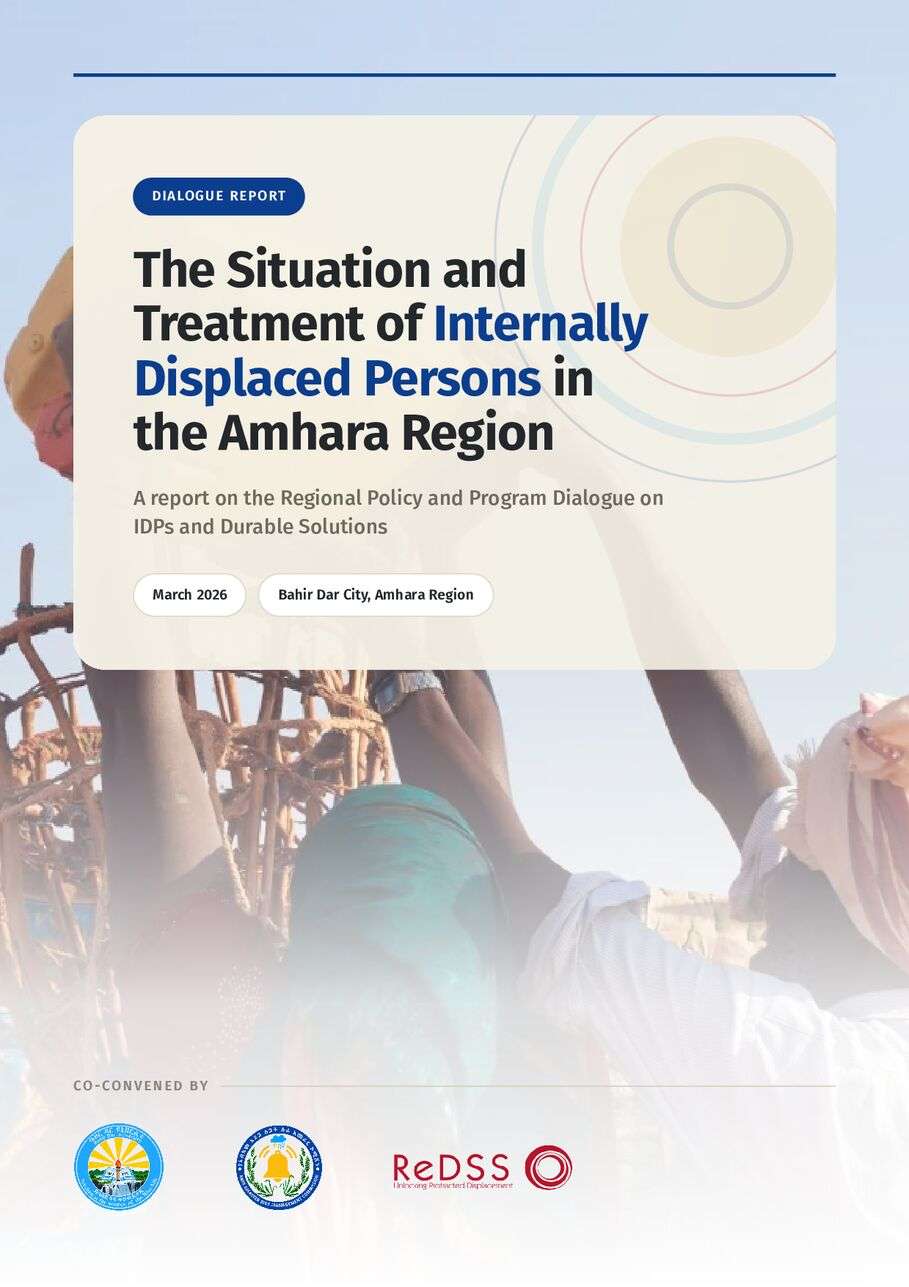
The Amhara Region is experiencing one of Ethiopia’s most complex humanitarian crises, and the report notes that it remains underrepresented in national and international policy discussions. The Regional Disaster and Risk Management Commission (DRMC) reports 602,112 people displaced within the region, most of them for over six years, while UNHCR and IOM report far lower figures. That discrepancy became a point of discussion at the dialogue. The report asks what the current situation of internally displaced persons (IDPs) is, how government and non-government actors are responding, and what this means for IDP governance in the region.
The dialogue had two parts. Five evidence presentations from the DRMC, Bahir Dar University, the Ethiopian Human Rights Commission and UNDP covered the scale and drivers of displacement, protection from sexual exploitation, abuse and harassment, psychosocial wellbeing, human rights monitoring and institutional response. A panel with the DRMC, the Amhara Region War-Affected Areas Rehabilitation and Reconstruction Fund Office and World Vision Ethiopia then reflected on achievements, challenges and the way forward.
The report records progress, including a regional Durable Solutions Strategy and Costed Action Plan, a revived Durable Solutions Working Group and an IDP database. It also documents poor shelter conditions, declining humanitarian funding, concerns about the conduct of returns, the absence of an IDP-specific national law and of a dedicated government body for displacement. Research presented at the dialogue found that the solutions IDPs prefer differ from those implemented in practice.
The six recommendations call for an inclusive national political dialogue on root causes, political will for peaceful conflict resolution, respect for international humanitarian responsibilities, prioritising local integration where return is neither safe nor practical, a stronger legal, institutional and coordination framework, and sustained financing. The report is relevant to government institutions, humanitarian and development actors, researchers and donors working on internal displacement in Ethiopia.