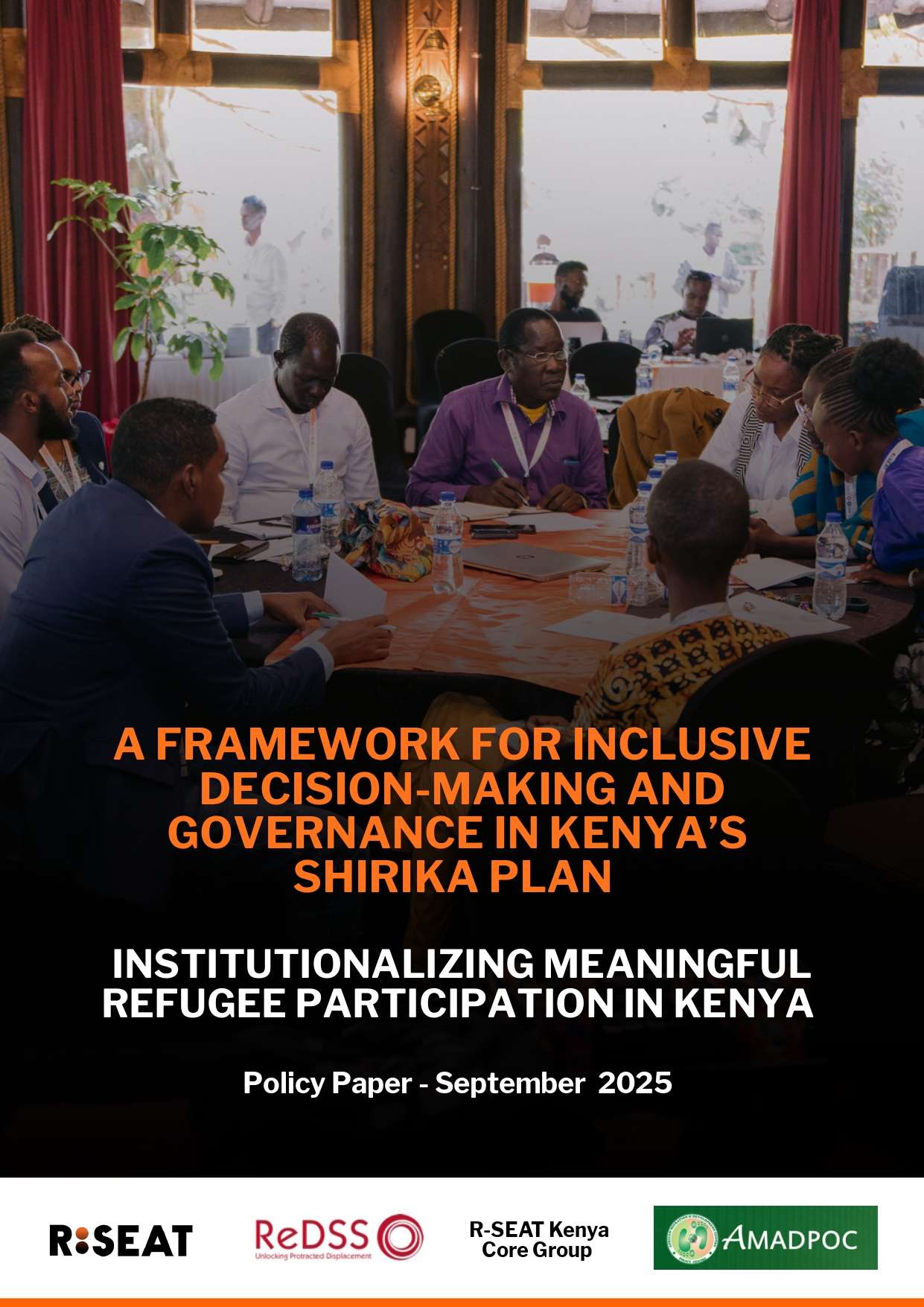
This policy paper, developed by Refugees Seeking Equal Access at the Table (R-SEAT) and partners – including the Regional Durable Solutions Secretariat (ReDSS), presents a comprehensive framework for institutionalizing meaningful refugee participation (MRP) in Kenya’s Shirika Plan. The Shirika Plan, launched in March 2025, marks a strategic shift from refugee encampment to settlement-based integration, aligning with Kenya’s Refugees Act (2021) and the Global Compact on Refugees (GCR). It envisions refugee camps as socio-economic hubs and aims to promote self-reliance, inclusion, and host-refugee integration.
The framework emphasizes that refugee participation must move beyond ad hoc consultations to structured, multi-level governance. It proposes the creation of a Blended Refugee Expert Committee to embed refugee voices in planning, implementation, and monitoring. The conceptual framework is built on five pillars: rights-based participation, multi-level governance, programmatic integration, contextual adaptability, and risk mitigation.
Insights from a multi-stakeholder workshop held in Nairobi in March 2025 revealed broad support for institutionalizing refugee participation. Stakeholders – including government, UNHCR, donors, and refugee-led organizations (RLOs) – agreed on the need for formal mechanisms, direct funding, and inclusive communication platforms.
Recommendations include reducing RLO registration barriers, supporting refugee-led service delivery, and integrating refugees into national advisory bodies. The paper positions Kenya as a regional leader in participatory refugee governance and calls for coordinated efforts to operationalize the framework. R-SEAT commits to supporting this process through technical guidance and resource mobilization, aiming to ensure that refugee expertise informs durable solutions and inclusive development.