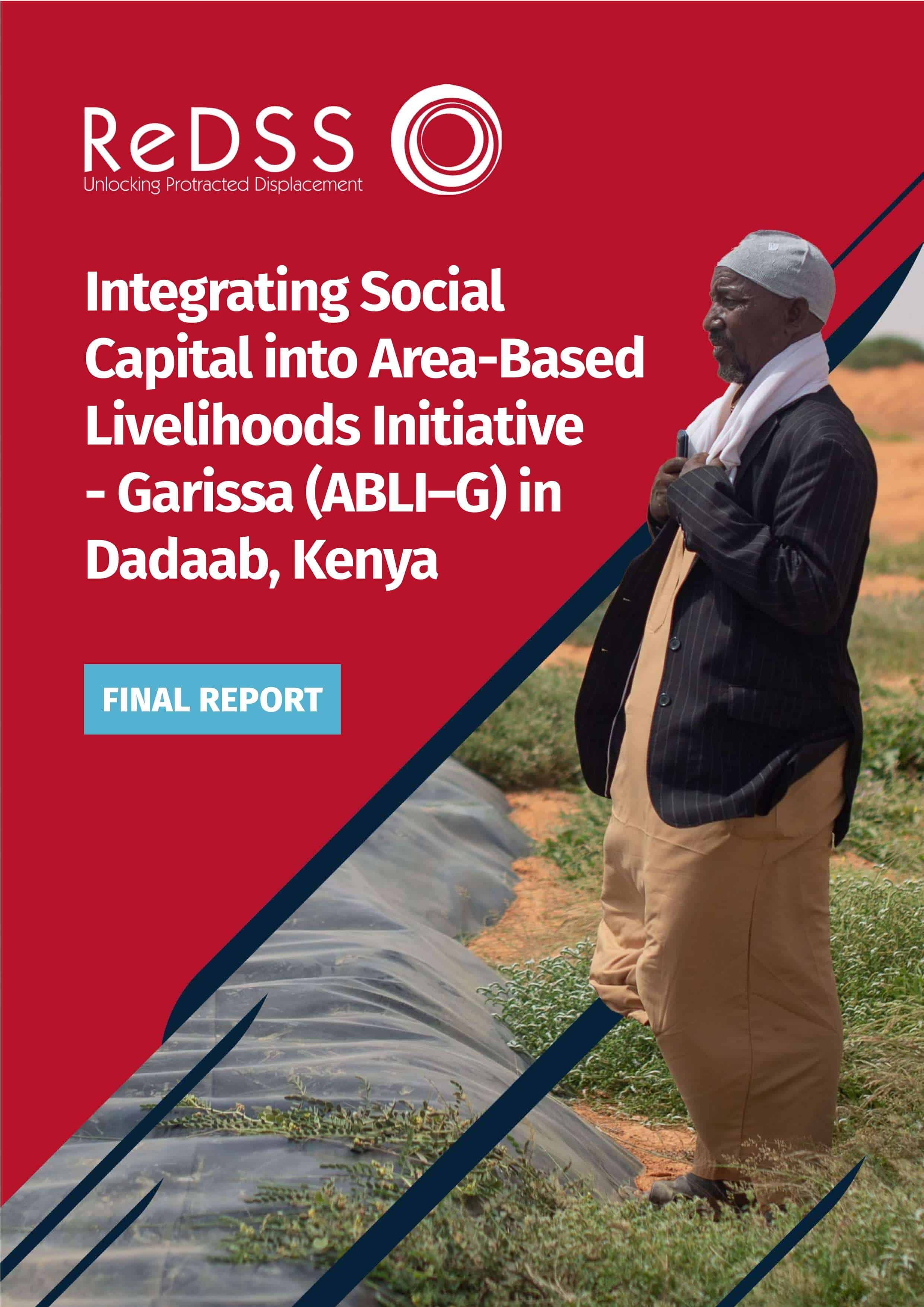
The policy brief, based on the ABLI-G II Social Capital Baseline Assessment, highlights the critical role of social capital in shaping access to opportunities, information, and services for displacement-affected communities in Dadaab. Social capital, defined through bonding, bridging, and linking networks, is shown to be unevenly distributed, with linking capital being the weakest and most consequential for accessing institutions, NGOs, and county services. Groups including women, persons with disabilities, minority clans, and newly arrived refugees face deep barriers related to language, mobility, digital access, and unfamiliarity with institutional procedures.
The assessment reveals a strong positive correlation between social capital and self‑reliance, with those possessing stronger networks better positioned to navigate institutions and improve their Self-Reliance Index scores. Digital dependence, particularly through WhatsApp communication channels, further widens gaps as vulnerable households lack devices, literacy, and connectivity. Institutional fear, gatekeeping practices, and clan dynamics also impede equitable access to information and services.
Policy implications include the need for social capital analysis in programme design, incorporation of multi-channel communication strategies, digital inclusion interventions, and assisted application pathways. Recommendations call on donors, government actors, and humanitarian organisations to strengthen bridging and linking networks, diversify outreach mechanisms, and address structural inequalities that disadvantage already marginalised groups.
Overall, the brief urges embedding social capital considerations into refugee inclusion frameworks, such as Kenya’s Shirika Plan, to ensure reforms promote equitable participation, reduce exclusion, and enhance long‑term self‑reliance for both refugees and host communities.