Updated October 2026: this post was first published in March 2020 to share our article. We have expanded it with a summary drawn from the article itself.
Issue 63 of Forced Migration Review, on cities and towns, brought together 20 articles by policymakers, practitioners, researchers, city representatives and displaced people on the challenges facing urban authorities and those who seek refuge in their cities. Our contribution, written by Mohamed Taruri of Baidoa Municipality, Laura Bennison of the Danwadaag Solutions Consortium, and Shezane Kirubi and Aude Galli of ReDSS, looks at Somalia. Its argument is that displacement is now shaping Somali towns and driving rapid urbanisation, that weak urban systems cannot meet the needs of hosts and displaced people alike, and that the answer lies in locally led, multi-stakeholder coordination under municipal leadership.
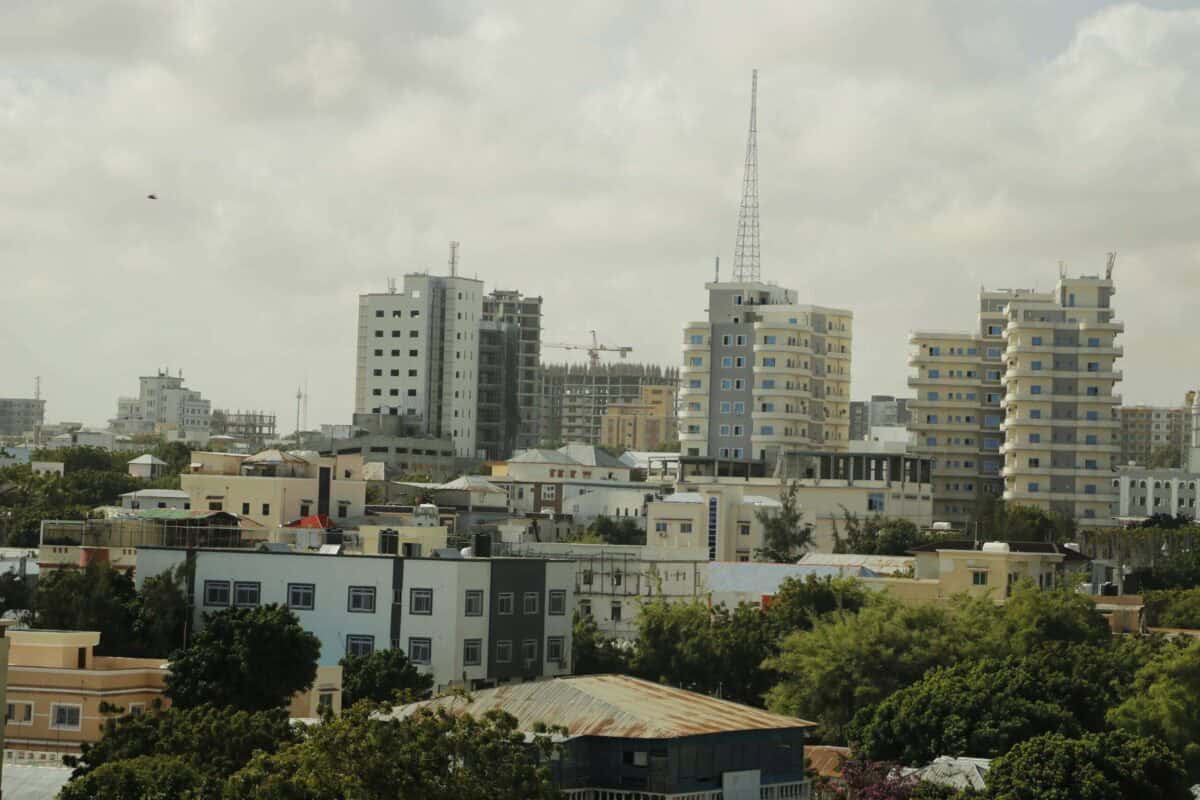
How displacement is reshaping Somali towns
Baidoa shows the pace of change. According to REACH data cited in the article, the town had 70 IDP sites before the 2017 drought and 435 by January 2019. Growth on this scale puts pressure on land, services and jobs, and pushes up land prices and the risk of eviction. The article argues for integrated, area-based programming that serves whole neighbourhoods, rather than programmes that target people according to their displacement status, and for combining early solutions with long-term planning.
Examples from Mogadishu, Baidoa and Kismayo
In Mogadishu, the World Bank, the EU-funded RE-INTEG programme and the Danwadaag consortium coordinated their support to the Banadir Regional Administration on land issues, including evictions and rising land prices, with plans to map IDP settlements and identify public land for resettlement. A durable solutions unit was set up in the city, and the Common Social Accountability Platform was piloted there: over four weeks of interactive radio, 3,267 people sent 14,391 text messages, and 51.2 percent of participants were displaced. In Baidoa and Kismayo, technical durable solutions working groups were established with UN and NGO support, and community action plans developed with the Midnimo model of IOM and UN-Habitat were consolidated by Danwadaag into district-level plans. The UN Resident Coordinator’s Office went on to replicate the radio platform in Baidoa and Bossaso, and in October 2019 the Federal Government set up a national Durable Solutions Secretariat.
Lessons for urban responses
The article draws out a set of lessons. Invest in the ability of local authorities to lead and coordinate, and in the ability of humanitarian agencies to work in development and political settings while keeping a principled humanitarian response. Use joint analysis to build a shared evidence base and a common planning narrative, and avoid parallel coordination structures. Make capacity development plans realistic, localised, collectively endorsed and multi-year, with indicators and milestones, and involve local authorities from the design stage.
Area-based planning should address five dimensions, spatial, physical, economic, social and institutional, link programmes to district development plans, and map existing interventions to find gaps. Community structures should be mapped at the outset so that programmes build on existing groups and plans, forming new groups only where they add real value; displaced communities should take part in monitoring, and block grants for community forums are worth considering. Social cohesion and inclusion should be strategic objectives in their own right. Urban planners and social, economic and governance specialists should be deployed early, in areas already receiving many displaced people. And urban durable solutions should be coordinated with rural resilience programming wherever security allows return.
The next step
The article ends by calling for multi-stakeholder approaches to measuring progress in durable solutions processes and to strengthening accountability, so that municipal leadership is matched by evidence of what is changing for residents.
Read our full article and the full FMR issue on cities and towns. See also the results of the Mogadishu radio pilot.
References
Taruri, M., Bennison, L., Kirubi, S. and Galli, A. (2020). Multi-stakeholder approach to urban displacement in Somalia. Forced Migration Review 63: Cities and towns. https://www.fmreview.org/cities/taruri-bennison-kirubi-galli