

Part 1 of a three-part series marking the 75th anniversary of the 1951 Refugee Convention.
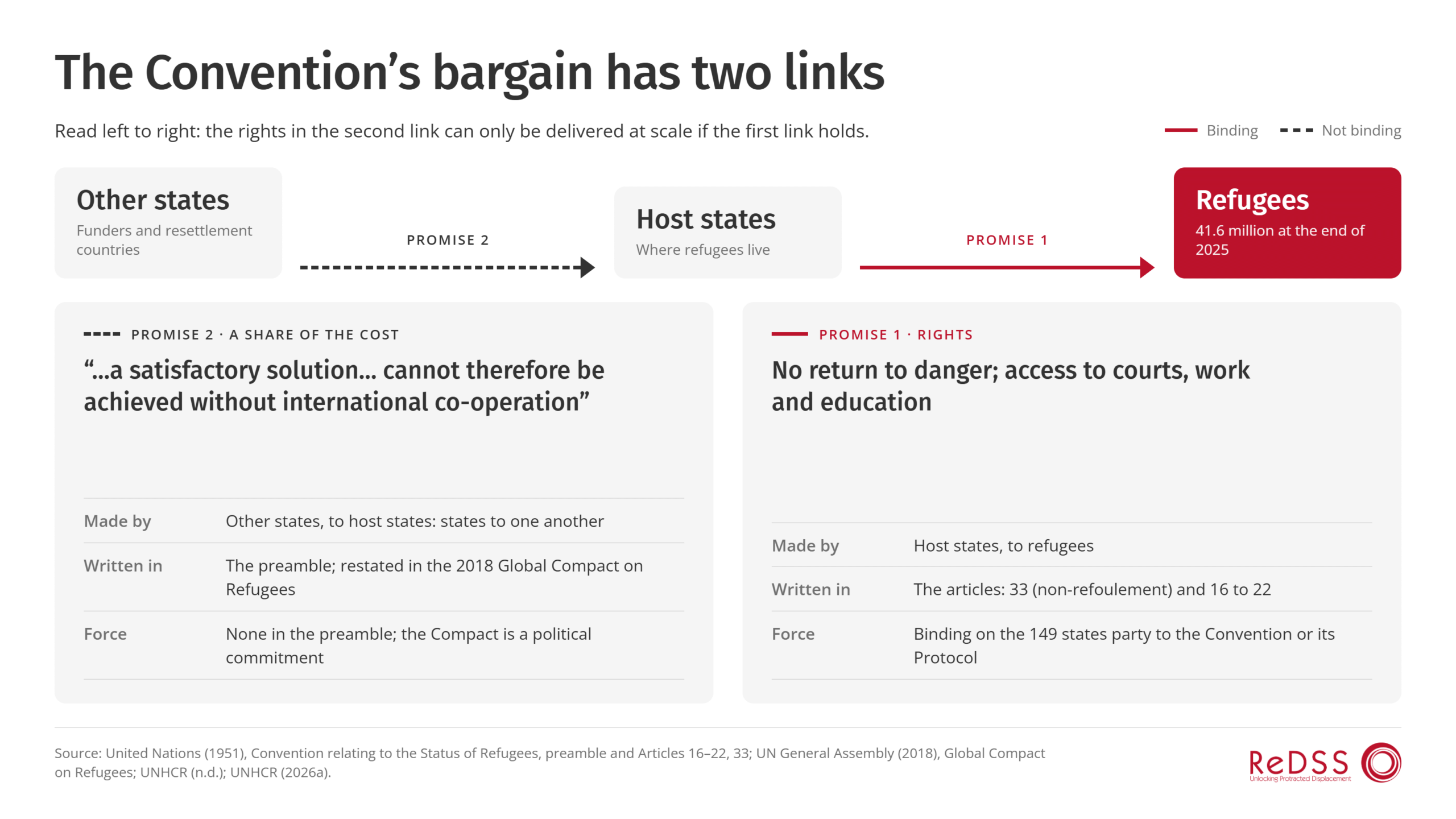
The 1951 Refugee Convention makes two promises at once, though only one of them gets quoted often. The first is the famous one, written into the Convention’s binding articles and owed to refugees themselves: a state party must not return a refugee to danger (Article 33), must give them access to courts, work, and education (Articles 16 to 22), must treat them as more than a temporary inconvenience. The second promise sits in the preamble, is made by states to one another, and is less often repeated: that granting asylum “may place unduly heavy burdens on certain countries,” and that solving displacement is therefore a problem no single state should have to carry alone. Unlike the first, it is a political commitment rather than a legal one, restated in the equally non-binding 2018 Global Compact on Refugees.
Between them, these two promises settle who protects refugees and who shares the cost of protecting them, which is the bargain this series tracks. Seventy-five years later, the first promise has largely held. The second has not, and we don’t think the two can be scored apart, because the rights host states extend in law can only be delivered at scale if the cost of delivering them is shared.
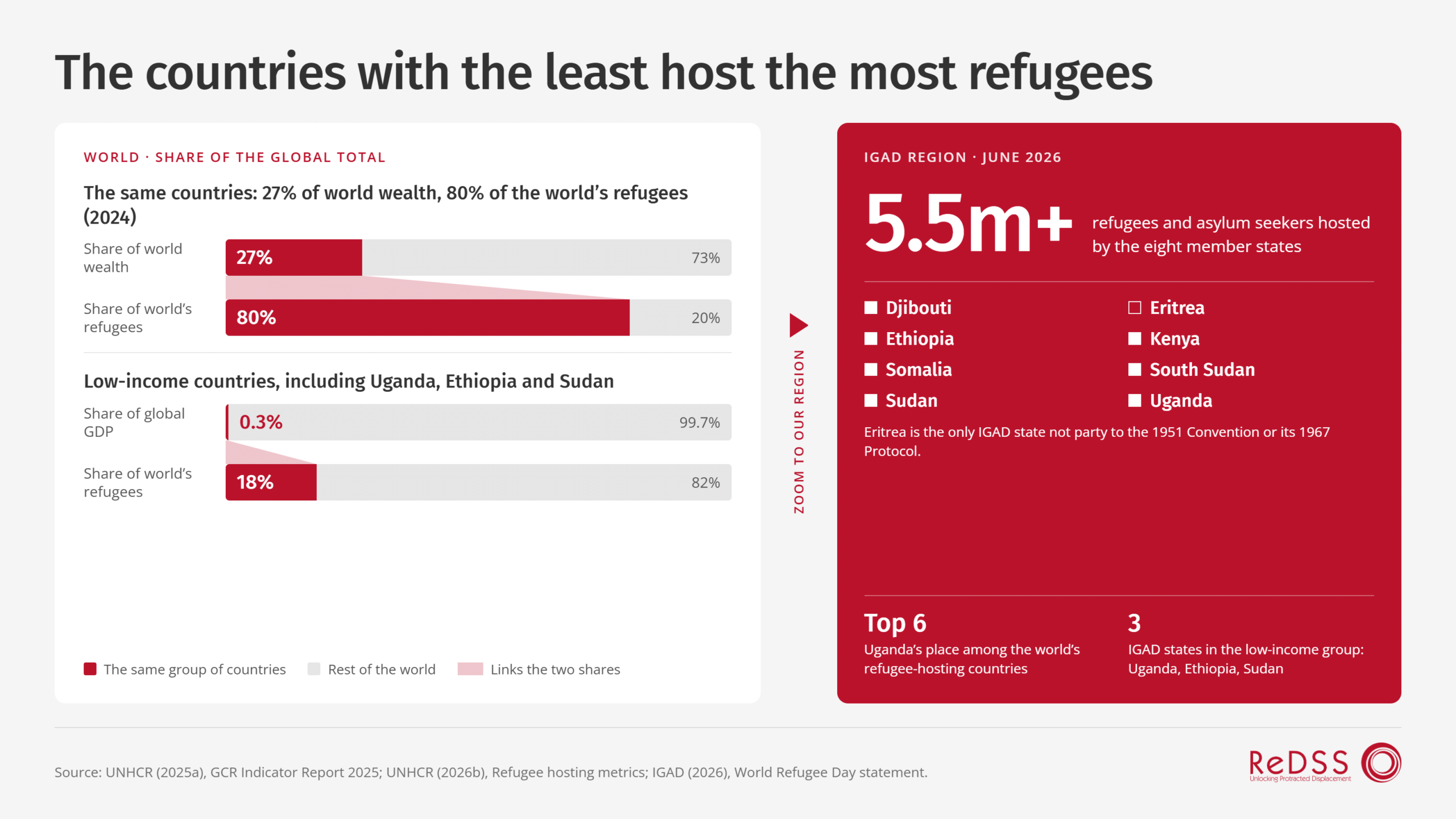
At the end of 2025, 41.6 million people were refugees, according to UNHCR’s Global Trends 2025 report. Sixty-eight percent of them live in low- and middle-income countries. Sixty-five percent live in a country neighbouring the one they fled. By UNHCR’s 2025 indicator report on the Global Compact on Refugees, countries holding just 27 percent of the world’s wealth hosted 80 percent of the world’s refugees in 2024. The pattern is long-standing, and since 2025 wealthy states have retreated further from resettlement and funding, leaving the countries already hosting the most refugees to cover the gap.
Nowhere is that imbalance plainer than in the region where we work. The eight member states of the Intergovernmental Authority on Development (IGAD) hosted more than 5.5 million refugees and asylum seekers as of June 2026, by IGAD’s count. Uganda is among the six largest refugee-hosting countries in the world, and UNHCR counts Uganda, Ethiopia and Sudan among the low-income countries that together produce 0.3 percent of global GDP yet host 18 percent of the world’s refugees. Except Eritrea, seven of the eight are party to the 1951 Convention or its 1967 Protocol.
Where the First Promise Held
Most of the 149 states party to the Convention or its 1967 Protocol have kept the more famous promise. Non-refoulement, the principle at the Convention’s core, is one of the handful of provisions no state may reserve against, and across the large majority of the world’s asylum systems it has not been formally abandoned. Across the IGAD region, legal protections (freedom of movement, work rights, access to services) have generally expanded rather than contracted over the past decade, with Ethiopia’s 2019 Refugees Proclamation and Kenya’s Refugees Act, 2021 among the clearest examples. In law, then, the first promise is holding; how far those rights reach a refugee standing in a work-permit queue depends on the second.
Where the Second Promise Didn't
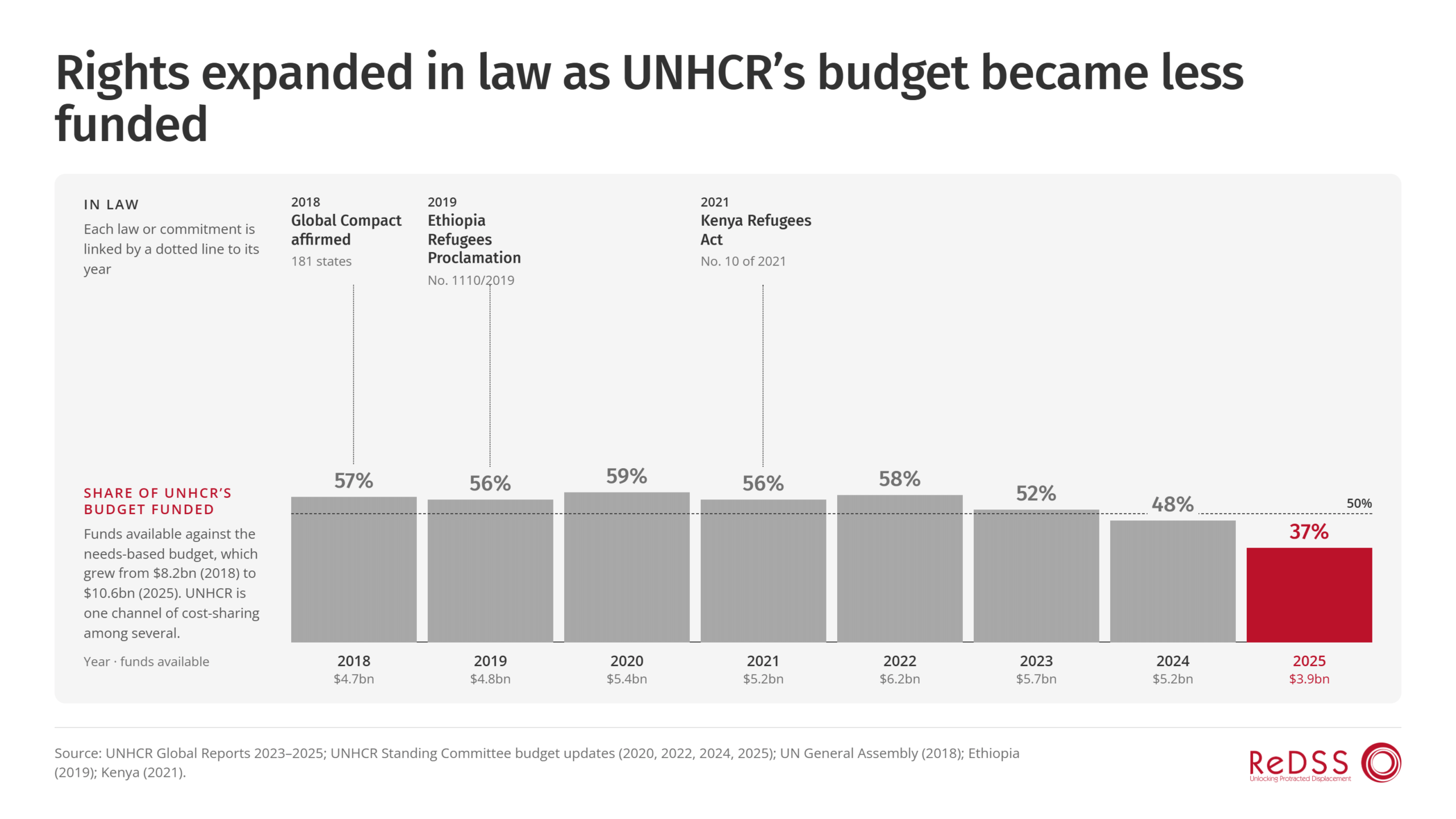
The Global Compact on Refugees, adopted in 2018 after the 2016 New York Declaration for Refugees and Migrants set the process in motion, and specifically to correct the imbalance in who hosts and who pays, has produced what UNHCR’s own indicator reporting calls a modest but consistent improvement in burden- and responsibility-sharing, alongside its own acknowledgement that responsibility remains lopsided. The financing half of that responsibility is shrinking. Official development assistance for refugees in low- and middle-income countries totalled USD 27.7 billion across 2022 and 2023, by the same report, and overall aid fell in 2024 and fell much further in 2025, by 23.1 percent according to preliminary OECD data, the largest drop on record. UNHCR ended the year with 63 percent of its budget unfunded.
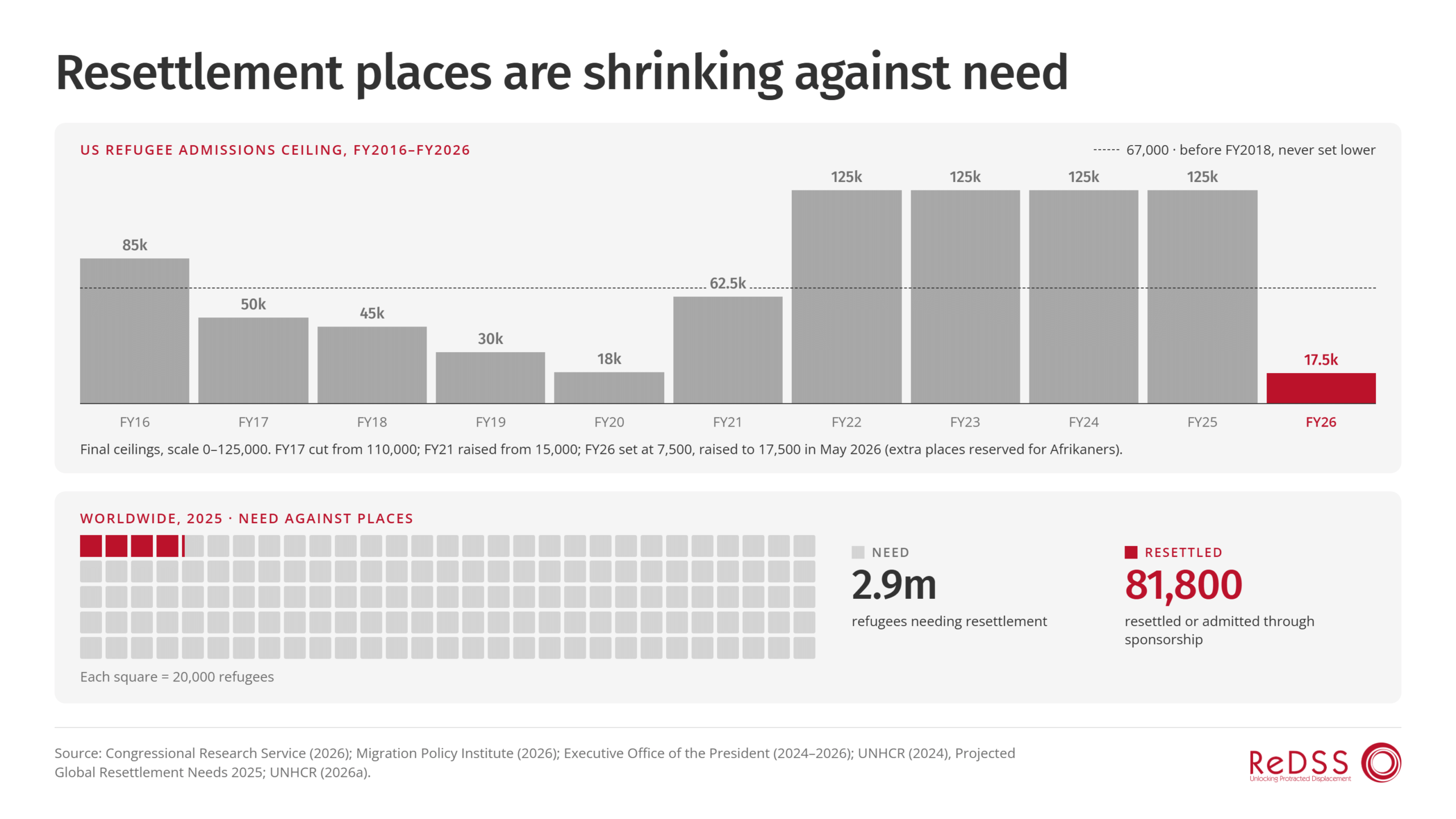
Resettlement tells a similar story. In October 2025, the United States, historically one of the world’s largest resettlement countries, set its refugee admissions ceiling for fiscal year 2026 at 7,500, the lowest since the programme began in 1980 and a fraction of the 125,000 ceiling set the year before. Before fiscal year 2018, the ceiling had never been set below 67,000. An emergency determination in May 2026 raised it to 17,500, with the extra places reserved for Afrikaners from South Africa, and that is still the lowest ceiling the programme has had. Across all resettlement countries, 81,800 refugees were resettled or admitted through sponsorship pathways in 2025, by UNHCR’s count, against needs the agency projected at 2.9 million for that year, roughly 35 people in need for every place delivered. The European Union’s pledge at the 2023 Global Refugee Forum, 31,000 resettlement places over two years within a wider 61,000-place package, was made against a global goal, set in 2019, of resettling one million refugees by 2028.
Each of these decisions is defensible on its own terms, and together they amount to a retreat no government has had to announce.
The Word 'Generous' Is Doing a Lot of Work Here
Part of what makes this hard to see clearly is the language around it. Hosting countries are routinely described as generous, as if asylum were a gift a country chooses to extend rather than half of a bargain two parties took on together. Wealthy states, meanwhile, get to frame reduced resettlement as a sovereign choice. In law it is one, since no state is obliged to resettle anyone. But 181 states affirmed the Global Compact on Refugees at the UN General Assembly in 2018, resettlement included (the United States was one of only two to vote against), and cutting places is a retreat from that political commitment even where it breaks no rule. The Convention’s own preamble, which creates no obligations but does record what its drafters intended, does not support that asymmetry: it was written on the premise that asylum has a cost, that the cost falls unevenly by accident of geography, and that fixing the accident was everyone’s job, rather than something hosting states do on behalf of those declining to help.
The Convention Is Failing in the Queue for a Work Permit
It is tempting to read the two promises as two different report cards: protection, mostly a pass; burden-sharing, mostly a fail. That reading is too generous to the second card, because it treats two connected promises as independent. Non-refoulement holds, largely, inside countries that were never meant to absorb its cost alone, and the strain of trying shows up as pressure on the very protections being celebrated. Legal rights keep expanding on paper in the countries hosting the most people, even as the funding and staffing needed to deliver them shrink, a pattern this series looks at closely in Part 2.
A Convention that survives in the text of national law while failing in the queue for a work permit, a food ration, or a registration appointment is running on the reserves of the states with the least capacity to keep supplying it. Host states still owe refugees the rights they have written into their own law, and the states that want those rights delivered owe a share of what delivering them costs.
The anniversary statements celebrating seventy-five years of lives saved keep skipping past the harder sentence in the Convention’s preamble: that international cooperation was written in as the precondition for any satisfactory solution. If the UNHCR-led dialogues running through 2026 are going to mean anything by the time the Agenda for the Future of Protection and Solutions is published in 2027, the honest test is delivery: dollars disbursed, and protection delivered through resettlement, complementary pathways, and support to host countries, rather than the size of the pledges.
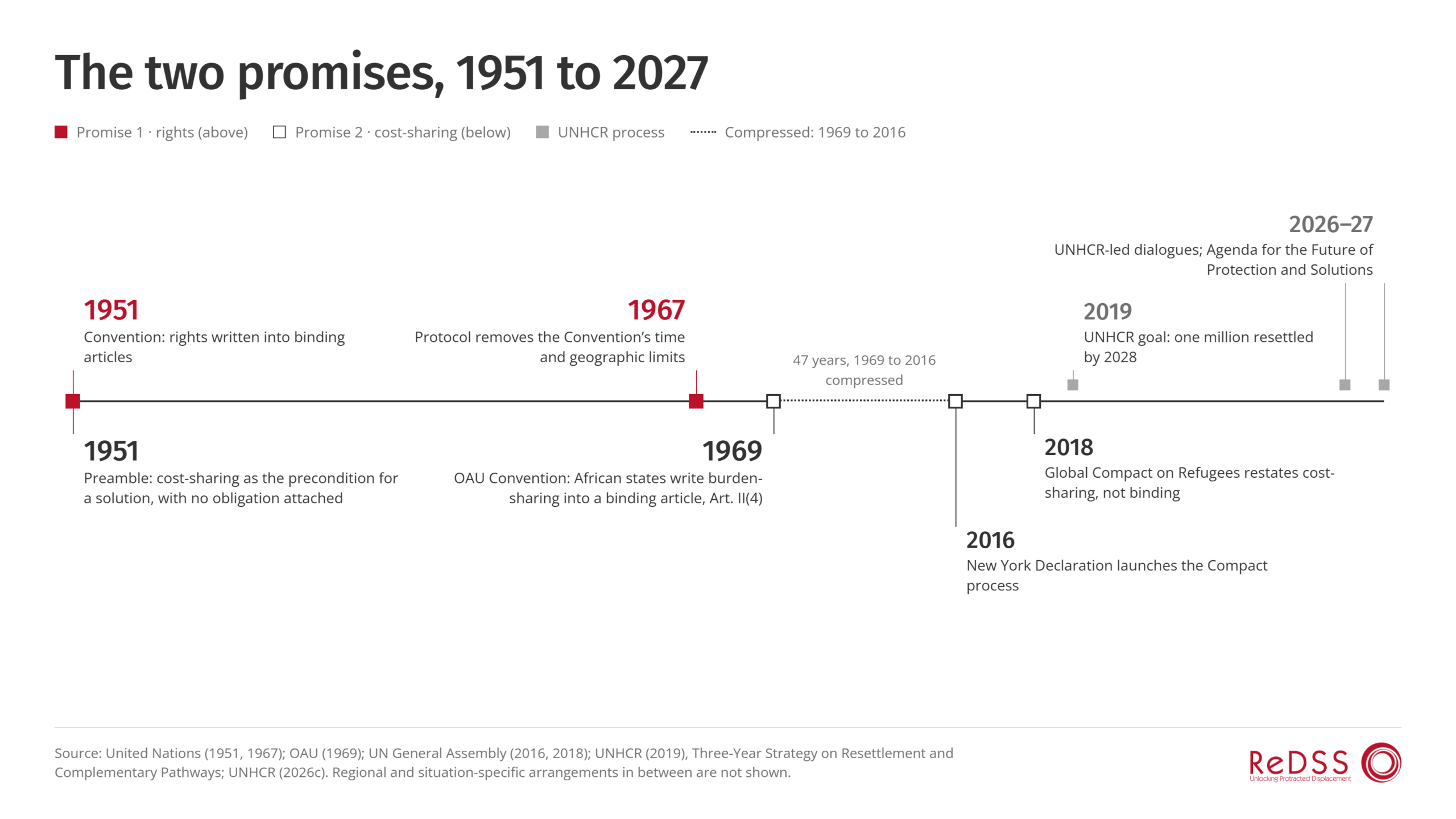
The second promise already has a precedent worth knowing about. Less than two decades after the 1951 Convention was signed, African states moved the same second promise out of a preamble and into the articles of a regional treaty of their own, aimed at each other rather than at distant capitals. Part 2 asks whether a promise made between neighbours holds up any better than one made across an ocean.
References
- Congressional Research Service (2026). U.S. Refugee Admissions Program in FY2025 and FY2026 (IF13277). Library of Congress. https://www.congress.gov/crs-product/IF13277
- European External Action Service (2023). Global Refugee Forum 2023. Delegation of the European Union to the UN and other international organisations in Geneva. https://www.eeas.europa.eu/delegations/un-geneva/global-refugee-forum-2023_en
- Executive Office of the President (2024). Presidential Determination on Refugee Admissions for Fiscal Year 2025 (Presidential Determination No. 2024-13). Federal Register, 89(202), 83767. https://www.federalregister.gov/documents/2024/10/18/2024-24321/presidential-determination-on-refugee-admissions-for-fiscal-year-2025
- Executive Office of the President (2025). Presidential Determination on Refugee Admissions for Fiscal Year 2026 (Presidential Determination No. 2025-13). Federal Register, 90(209), 49005–49006. https://www.govinfo.gov/content/pkg/FR-2025-10-31/pdf/2025-19752.pdf
- Executive Office of the President (2026). Emergency Presidential Determination on Refugee Admissions for Fiscal Year 2026 (Presidential Determination No. 2026-14). Federal Register, 91(101), 31645. https://www.govinfo.gov/content/pkg/FR-2026-05-27/pdf/2026-10598.pdf
- Federal Democratic Republic of Ethiopia (2019). Refugees Proclamation No. 1110/2019. Federal Negarit Gazette. Ministry of Justice. https://justice.gov.et/en/law/refugees-proclamation-proclamation/
- Intergovernmental Authority on Development (2026). Statement of H.E. Dr. Workneh Gebeyehu, Executive Secretary of the Intergovernmental Authority on Development (IGAD), on World Refugee Day 2026. IGAD. https://igad.int/statement-of-h-e-dr-workneh-gebeyehu-executive-secretary-of-the-intergovernmental-authority-on-development-igad-on-world-refugee-day-2026/
- OECD (2026). A historic decline in foreign aid: Preliminary 2025 ODA data. Organisation for Economic Co-operation and Development. https://www.oecd.org/en/data/insights/data-explainers/2026/04/a-historic-decline-in-foreign-aid-preliminary-2025-oda-data.html
- Organization of African Unity (1969). Convention Governing the Specific Aspects of Refugee Problems in Africa. United Nations Treaty Series, 1001, 45. African Union. https://au.int/en/treaties/oau-convention-governing-specific-aspects-refugee-problems-africa
- Republic of Kenya (2021). The Refugees Act, 2021 (No. 10 of 2021). Kenya Gazette Supplement No. 210. Department of Refugee Services. https://refugee.go.ke/sites/default/files/downloads/Refugees-Act-2021.pdf
- UNHCR (2020). UNHCR appeals for resettlement places as record forced displacement and protection needs outstrip solutions. UNHCR. https://www.unhcr.org/us/news/news-releases/unhcr-appeals-resettlement-places-record-forced-displacement-and-protection
- UNHCR (2023). 2022 Global Figures at a Glance: Refugee Resettlement Facts. UNHCR USA. https://www.unhcr.org/us/sites/en-us/files/legacy-pdf/639929dd4.pdf
- UNHCR (2024). Projected Global Resettlement Needs 2025. UNHCR. https://www.unhcr.org/sites/default/files/2024-05/projected-global-resettlement-needs-2025.pdf
- UNHCR (2025a). Global Compact on Refugees Indicator Report 2025. UNHCR. https://www.unhcr.org/publications/indicator-report-2025
- UNHCR (2026a). Global Trends: Forced Displacement in 2025. UNHCR. https://www.unhcr.org/sites/default/files/2026-06/global-trends-report-2025.pdf
- UNHCR (2026b). Refugee hosting metrics. UNHCR Refugee Data Finder. https://www.unhcr.org/refugee-statistics/insights/explainers/refugee-hosting-metrics.html
- UNHCR (2026c). 75 years of lives changed. UNHCR. https://www.unhcr.org/75-anniversary
- UNHCR (2026d). Global Report 2025. UNHCR. https://www.unhcr.org/publications/global-report-2025
- UNHCR (n.d.). The 1951 Refugee Convention. UNHCR. https://www.unhcr.org/about-unhcr/overview/1951-refugee-convention
- United Nations (1951). Convention relating to the Status of Refugees. United Nations Treaty Series, 189, 137. https://www.unhcr.org/sites/default/files/2025-02/1951-refugee-convention-1967-protocol.pdf
- United Nations (2018). General Assembly endorses landmark Global Compact on Refugees, adopting 53 Third Committee resolutions, 6 decisions covering range of human rights (GA/12107). UN Meetings Coverage and Press Releases. https://press.un.org/en/2018/ga12107.doc.htm
- United Nations General Assembly (2016). New York Declaration for Refugees and Migrants (A/RES/71/1). United Nations. https://undocs.org/en/A/RES/71/1
- United Nations General Assembly (2018). Report of the United Nations High Commissioner for Refugees, Part II: Global compact on refugees (A/73/12 (Part II)). United Nations. https://globalcompactrefugees.org/sites/default/files/2019-12/Global%20compact%20on%20refugees%20EN.pdf


