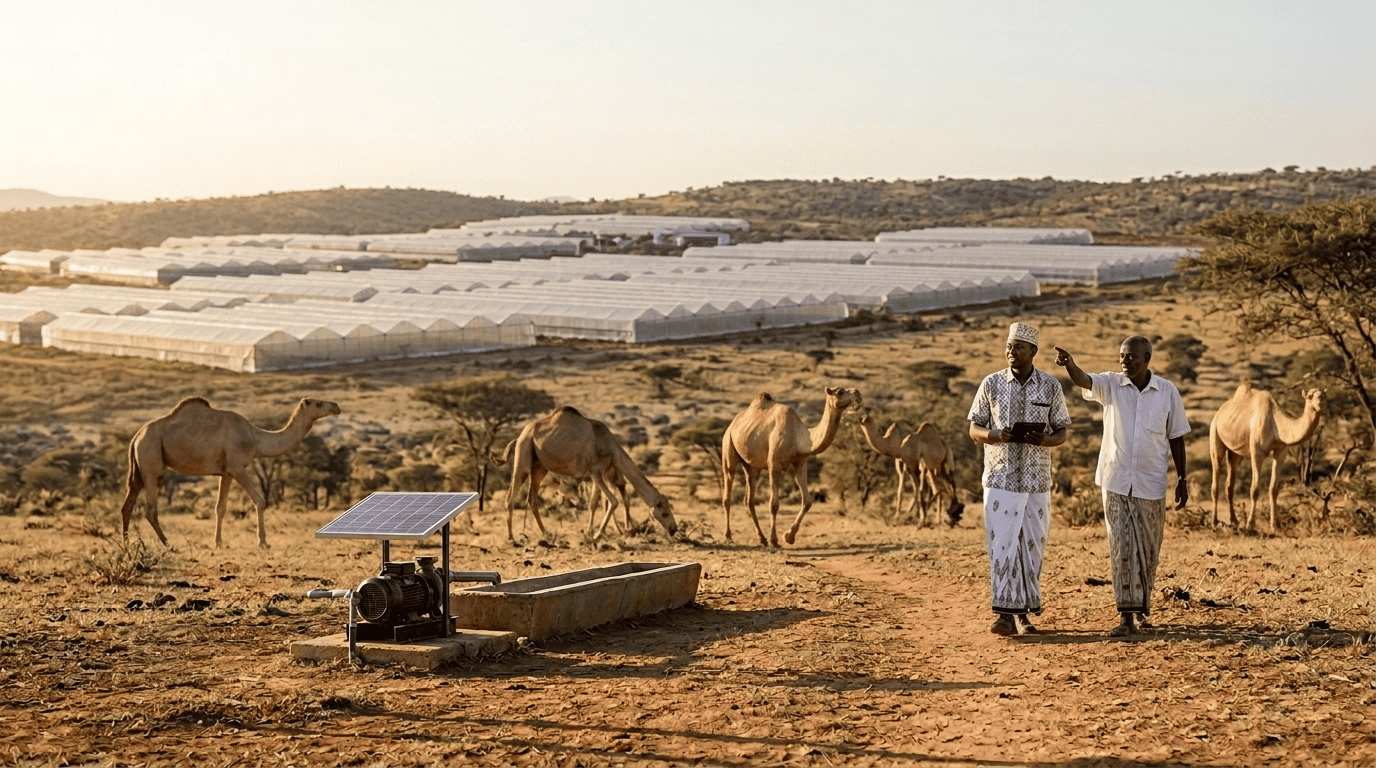

Part 3 of a three-part series marking the 75th anniversary of the 1951 Refugee Convention, following Part 1 on the global bargain and Part 2 on Africa’s 1969 solidarity clause. Part 2 closed on what the global and regional promises have in common: states made them to each other, and the people seeking asylum had no say in how either would be kept. This part asks what that say would take, drawing on ReDSS’s research with refugees and internally displaced people across the region.
“We live by the grace of God.” That is how one refugee woman in Nairobi summed up her relationship to the organisations that decide her future, in interviews we published in August 2025. Others in the same discussion said much the same thing more plainly: that no organisation wants to meet with refugees directly, and that decisions get made for them with no chance to speak in front of the people making them.
The study is called From Tokenism to Ownership, and it comprises 134 interviews and discussions across Ethiopia, Kenya, Uganda, Tanzania, and Somalia and Somaliland, conducted and co-authored by seven researchers who themselves have lived experience of displacement. It set out to answer a question the Convention itself never got around to asking: what does it actually take for the people a protection system exists to serve to have a say in how it works?
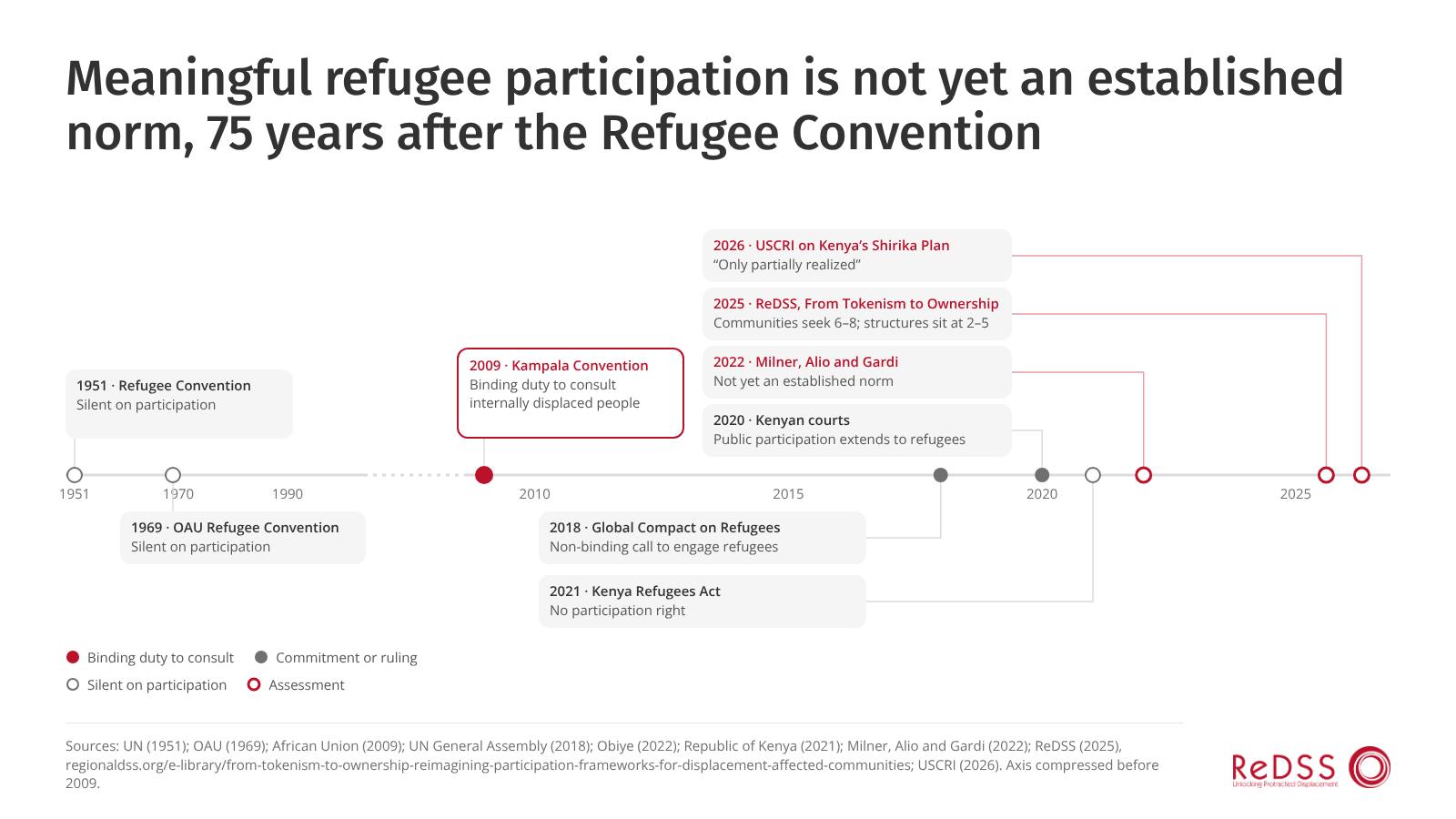
The 1951 Convention does not mention participation at all. It guarantees rights, from non-refoulement to access to courts, work, and education, but it never asks a host state to ask a refugee anything. Seventy-five years on, that silence still shapes what protection means on the ground, and our fieldwork shows how far that silence reaches.
A Ladder Nobody Built for Them to Climb
The study adapted Arnstein’s 1969 Ladder of Citizen Participation into an eight-level scale for displacement settings, running from manipulation and decoration at the bottom to refugee-initiated collaboration and refugee-led action at the top. Taken together, displaced communities said they wanted to be at Levels 6 to 8, where decisions are shared and communities take ownership and initiative. “For me, meaningful participation means power-sharing and having real influence, not just input,” one Dadaab participant said. Government and agency structures, the study found, cluster instead at Levels 2 to 5, closer to decoration, tokenism, information-sharing, and consultation, a gap of as many as six rungs.
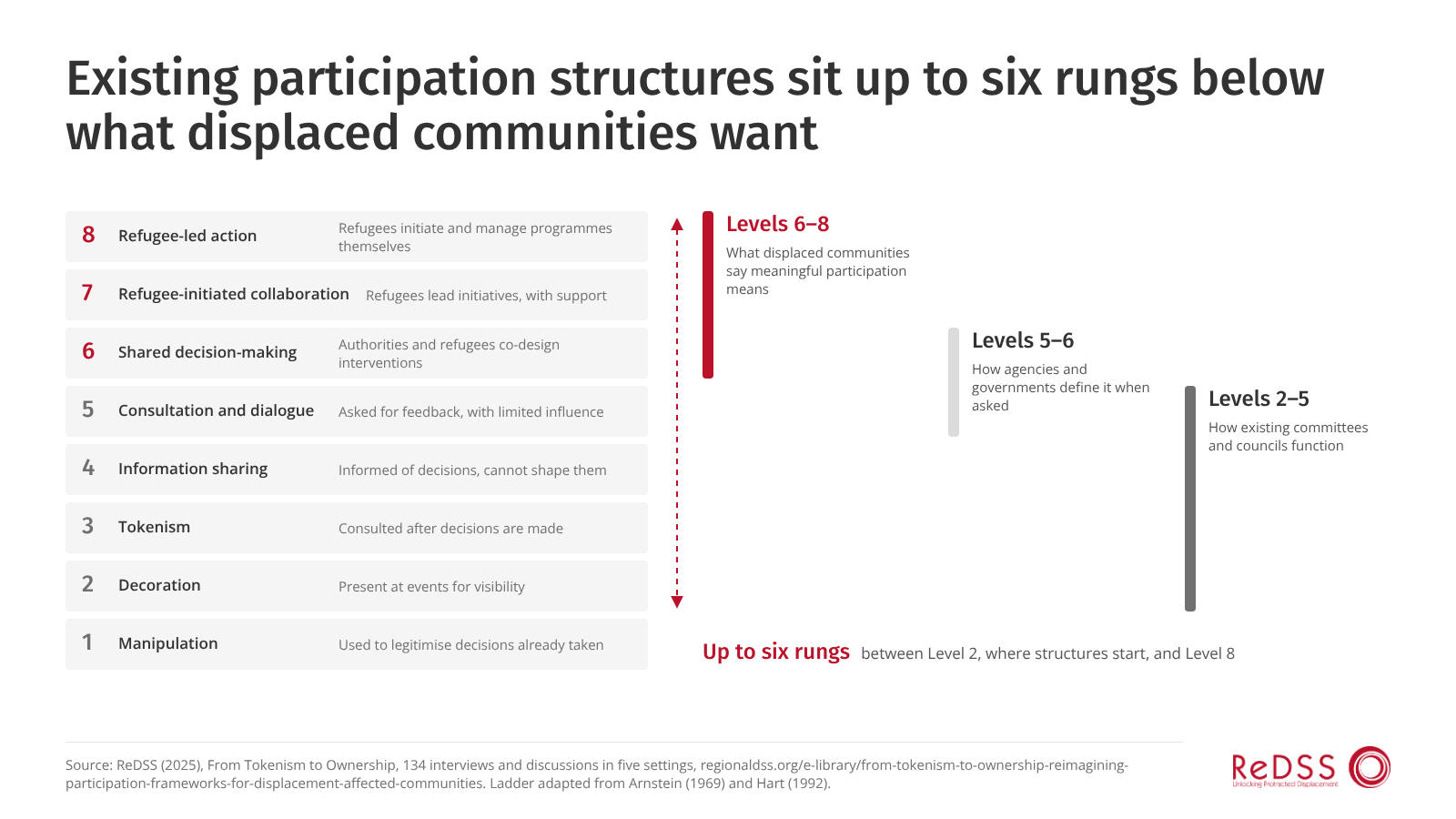
In Kampala, a refugee leader described what that distance looks like in practice: feedback, they said, goes mostly to the specific group of refugees who benefited, “not the entire community.” In Addis Ababa, refugees described being invited to meetings that go nowhere and, in at least one case, being met by police for asking about delayed payments. The floor of what counts as participation, in other words, has settled well below what displaced communities themselves call meaningful.
Where the Law Asks for Participation, and Where It Doesn't
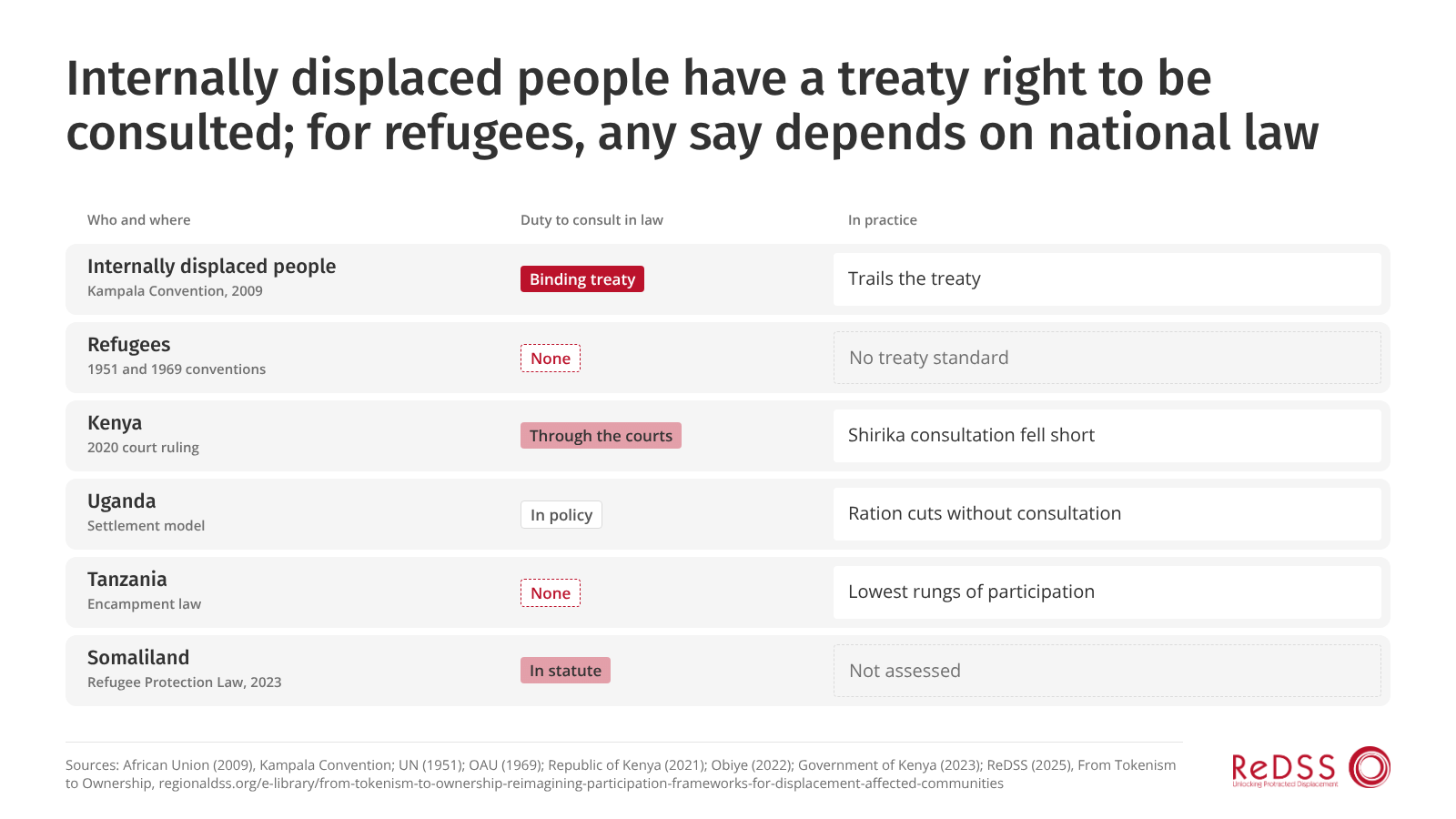
The law accounts for some of that gap, and the account differs for IDPs and refugees. The Kampala Convention, the African Union’s 2009 treaty on internal displacement, is explicit: states are obligated to consult internally displaced people (IDPs) and let them participate in decisions about their own protection and assistance. That is a binding commitment the 1951 and 1969 refugee conventions never made for refugees at all. In Kenya, refugees’ firmest legal footing is constitutional rather than statutory: in 2020 the courts struck down the Refugee Community Leader Election Guidelines because refugees had not been consulted, holding that the Constitution’s public participation requirement extends to them. The Refugees Act, 2021, which expanded refugees’ work and movement rights, creates no right to participation. The Shirika Plan went further in process than the law: its 2023 design brief set aside a consultation with refugee-led organisations and seats for refugee representatives on its technical committee. Refugees and community leaders say that consultation still fell short of meaningful.
At country level, practice is uneven. Our fieldwork found Ugandan refugees describing food ration cuts handed down with no consultation, “the refugees only receive ready-made rules,” despite a settlement model that allows for shared decision-making on paper. Tanzania’s encampment law locks refugees at the bottom of the ladder outright: they cannot leave camp without a permit, and have few formal channels to shape the decisions made inside it. Somaliland, though unrecognised as a state, has built a 2001 constitution, a 2012 national policy, a 2023 Refugee Protection Law, and a dedicated displacement agency tasked with consulting both IDPs and refugees, which suggests the architecture depends more on a government’s willingness than on its international standing. Parts 1 and 2 found promises that held on paper and stalled in practice. Participation splits that pattern: for IDPs, practice trails a binding treaty that requires consultation, while for refugees no treaty asks for it, and the national footholds that do exist, in Kenya’s courts or Uganda’s settlement model, have yet to change what refugees describe.
Independent Studies Find the Same Gap
Other researchers reach the same conclusion. A peer-reviewed 2022 study by Milner, Alio, and Gardi in Refugee Survey Quarterly concludes that meaningful refugee participation is not yet an established norm in the global refugee regime, a more cautious verdict than the language of the 2018 Global Compact on Refugees alone would suggest. The U.S. Committee for Refugees and Immigrants (USCRI), commenting on Kenya’s Shirika Plan a year after it launched, reached a similar verdict, calling the plan’s promise “only partially realized.” In USCRI’s reading, the plan has been strained further by the same funding cuts traced in Parts 1 and 2, and its success depends on whether refugees are actually included through refugee-led organisations and local consultation rather than on whether the plan exists on paper.
Where Ownership Already Exists
The more hopeful half of our findings is that refugees are already building what formal structures have not. In Dadaab, refugees have led community data collection, not just as respondents but, as one woman put it, as “the one asking questions, interpreting the finding and presenting insights.” Humanity & Inclusion built mobile outreach and participatory mapping in Dadaab specifically to reach people with disabilities whom standard consultation formats miss. The barriers it surfaced, fear of discrimination, inaccessible food distribution points and a lack of assistive devices, were ones those formats had never asked about. Refugee-led organisations like Halgan CBO in Dadaab, and networks like RELON in Uganda, which co-convened more than 50 refugee leaders with government, UN and NGO representatives in Kampala in May 2024, are already doing work formal structures were supposed to do. On the IDP side, people described relying on grassroots groups such as Danwadaag, where young women “help by setting up space” and learn leadership from their mothers. None of it waited for a treaty amendment.
The Room and the Decision
The report traces much of the gap to one structural choice: Refugee engagement structures are set up to answer to governments and humanitarian agencies rather than to the communities they claim to represent. It explains why one international NGO staffer in Addis Ababa described meaningful participation as something that happens “when refugees get employment and are beneficiary from the programmes,” collapsing participation into service delivery. It explains a Kampala participant’s complaint that monitoring frameworks are “meant to sound fancy by the staff,” numbers reported upward with no mechanism for anything to come back down. A structure built to answer to a government will answer to a government, however sincerely the people running it define meaningful participation when asked directly.
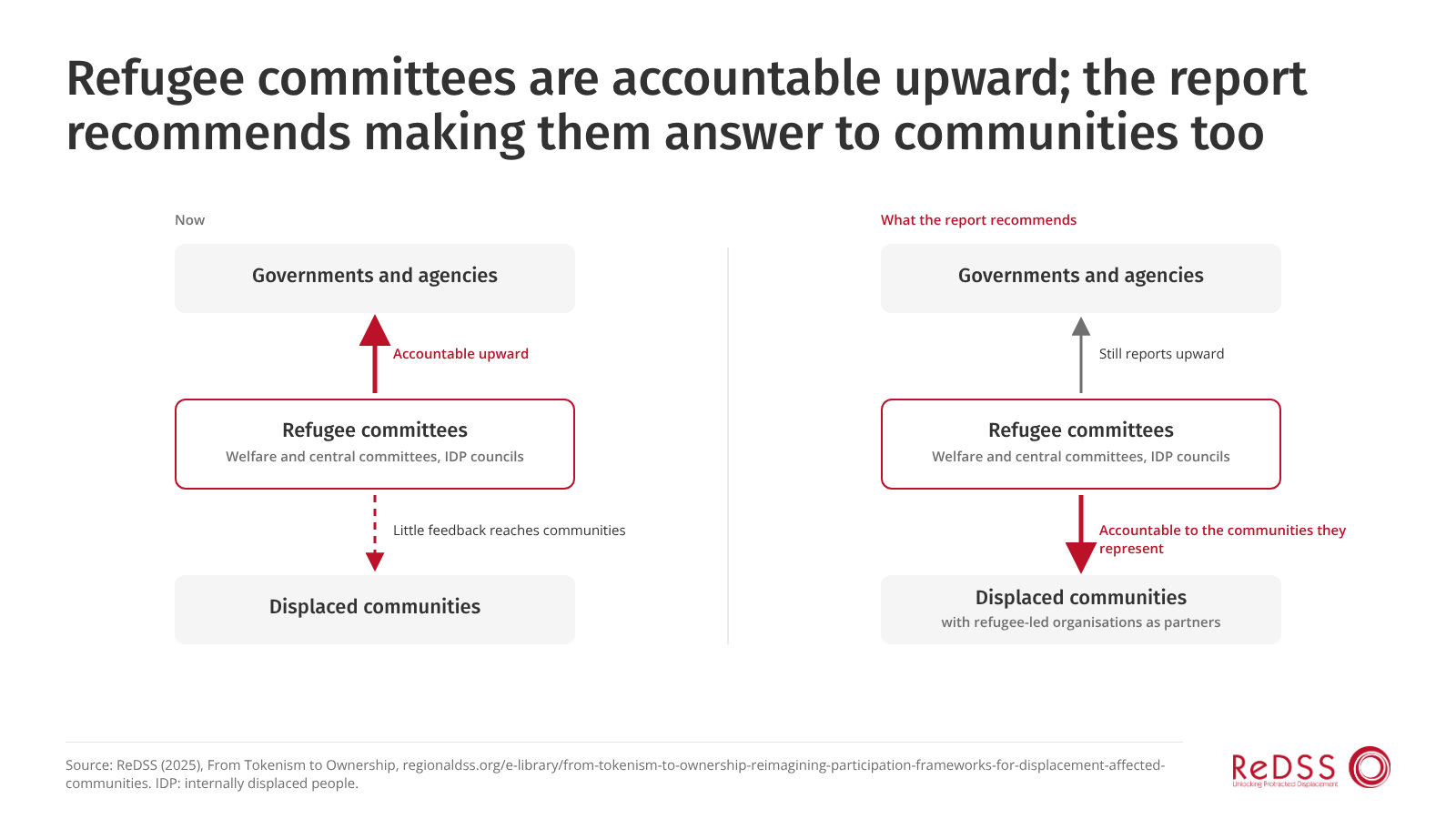
Read against Parts 1 and 2, the pattern completes itself. Globally, the wealthiest states have retreated from the promise of shared cost, a political commitment rather than a legal one. Regionally, African states wrote the same promise into binding law in 1969 and never built it into a standing mechanism. And neither was negotiated with the people it was meant to serve, an omission every country in this study is still living with, seventy-five years on.
What is different about this scale is that fixing it depends less on new money than on where existing money goes, and needs no treaty clause to be revived. The Intergovernmental Authority on Development (IGAD) Support Platform, which Part 2 proposed as the regional vehicle for an Article II (4) appeal made through the African Union, already hosts the IGAD Refugee Engagement Forum, launched in Kampala in November 2024 to bring refugee representatives into regional decision-making. A 2026 piece published by the Hilton Foundation names the platform among the processes that must put refugee-led organisations at the centre. Our recommendations follow the same logic, calling for an end to parallel committees, funding for what refugees have already built, and committees that answer downward as well as up. The regional promise stalled because no one was given the job of delivering it. At this scale, the job has an obvious holder: the agencies and donors that fund engagement structures, and that can decide those structures will answer to the people they represent.
References
- African Union (2009). African Union Convention for the Protection and Assistance of Internally Displaced Persons in Africa (Kampala Convention). https://au.int/sites/default/files/treaties/36846-treaty-kampala_convention.pdf
- Arnstein, S. R. (1969). A ladder of citizen participation. Journal of the American Institute of Planners, 35(4), 216–224. https://doi.org/10.1080/01944366908977225
- Government of Kenya (2023). Government of Kenya SHIRIKA Plan (brief, July 2023). UNHCR Operational Data Portal. https://data.unhcr.org/en/documents/download/104460
- IGAD (2024). IGAD, refugee groups, refugee representatives, member states and partners launch the IGAD Refugee Engagement Forum. 27 November 2024. https://igad.int/igad-refugee-groups-refugee-representatives-member-states-partners-launch-the-igad-refugee-engagement-forum/
- Ishimwe, J. M. (2026). Centering those who are closest: How funders can ensure refugee-led organizations are leading in localization efforts. Conrad N. Hilton Foundation. https://www.hiltonfoundation.org/news/centering-those-who-are-closest-how-funders-can-ensure-refugee-led-organizations-are-leading-in-localization-efforts/
- Milner, J., Alio, M. and Gardi, R. (2022). Meaningful refugee participation: An emerging norm in the global refugee regime. Refugee Survey Quarterly, 41(4), 565–593. https://doi.org/10.1093/rsq/hdac007
- Obiye, L. (2022). Hear my voice: refugees’ participation in Kenyan policy development. Forced Migration Review, 70. https://www.fmreview.org/issue70/obiye/
- Organisation of African Unity (1969). Convention Governing the Specific Aspects of Refugee Problems in Africa. https://au.int/en/treaties/oau-convention-governing-specific-aspects-refugee-problems-africa
- ReDSS (2025). From Tokenism to Ownership: Reimagining Participation Frameworks for Displacement Affected Communities. Nairobi: Regional Durable Solutions Secretariat. https://www.regionaldss.org/e-library/from-tokenism-to-ownership-reimagining-participation-frameworks-for-displacement-affected-communities/
- Republic of Kenya (2021). The Refugees Act, 2021 (No. 10 of 2021). Kenya Gazette Supplement No. 210. https://refugee.go.ke/sites/default/files/downloads/Refugees-Act-2021.pdf
- RSRI, RefugePoint, RELON Uganda and R-SEAT (2024). Refugee-Led Organization (RLO) Involvement in Local Decision Making: Challenges and Opportunities. https://www.refugeeselfreliance.org/resource-database1/rlo-involvement-in-local-decision-making-uganda
- United Nations (1951). Convention Relating to the Status of Refugees. https://www.unhcr.org/sites/default/files/2025-02/1951-refugee-convention-1967-protocol.pdf
- United Nations General Assembly (2018). Report of the United Nations High Commissioner for Refugees, Part II: Global compact on refugees (A/73/12 (Part II)), affirmed in A/RES/73/151. https://globalcompactrefugees.org/sites/default/files/2019-12/Global%20compact%20on%20refugees%20EN.pdf
- U.S. Committee for Refugees and Immigrants (2025). Toward a Shared Future: Advancing Refugee Integration in Kenya. 13 May 2025. https://refugees.org/toward-a-shared-future-advancing-refugee-integration-in-kenya/
- U.S. Committee for Refugees and Immigrants (2026). Statement – One Year On: Advancing the Promise of Kenya’s Shirika Plan. https://refugees.org/statement-one-year-on-advancing-the-promise-of-kenyas-shirika-plan/