

Part 2 of a three-part series marking the 75th anniversary of the 1951 Refugee Convention. Part 1 looked at the global bargain and closed by asking whether a promise made between neighbours holds up any better than one made across an ocean. This part looks at the region’s version to find out.
Article II (4) of the 1969 Organisation of African Unity (OAU) Refugee Convention says that when a member state struggles to keep granting asylum, other African states shall, “in the spirit of African solidarity,” take measures to lighten its load, once that state appeals to them directly or through the OAU. It is the second promise Part 1 traced, this time in an operative article of a binding treaty and in the language of obligation. That makes its neglect harder to explain than the global retreat Part 1 described. The 1969 Convention also widened the refugee definition to cover people fleeing generalised violence, not only individual persecution, and normalised prima facie recognition, entire groups declared refugees at once. Those two innovations get most of the attention; Article II (4) gets almost none. This piece asks what it would take, fifty-seven years on, to put the clause to work.
What the Region Built
Measured against the two promises Part 1 set out, East Africa and the Horn’s record over the past decade shows states doing more with the first promise, keeping asylum open and writing refugee rights into national law, than anyone has done with the second, the shared cost Article II (4) was written to cover. Uganda’s 2006 Refugees Act granted the right to work, freedom of movement, and land, and became a model UNHCR held up for other governments to learn from. Kenya’s Refugees Act, 2021, extended similar rights and now underpins the Shirika Plan, a multi-year effort to convert Dadaab and Kakuma into integrated settlements. Ethiopia’s 2019 Refugees Proclamation extended its out-of-camp policy to all nationalities and introduced a formal right-to-work directive. Beyond IGAD’s membership, Tanzania, an East African Community state and a party to the 1969 Convention, naturalised some 162,000 Burundian refugees in 2014, people who had fled in 1972; according to UNHCR, that was the largest group ever offered citizenship by a country of first asylum in its history.
Where Legislation Outran Delivery
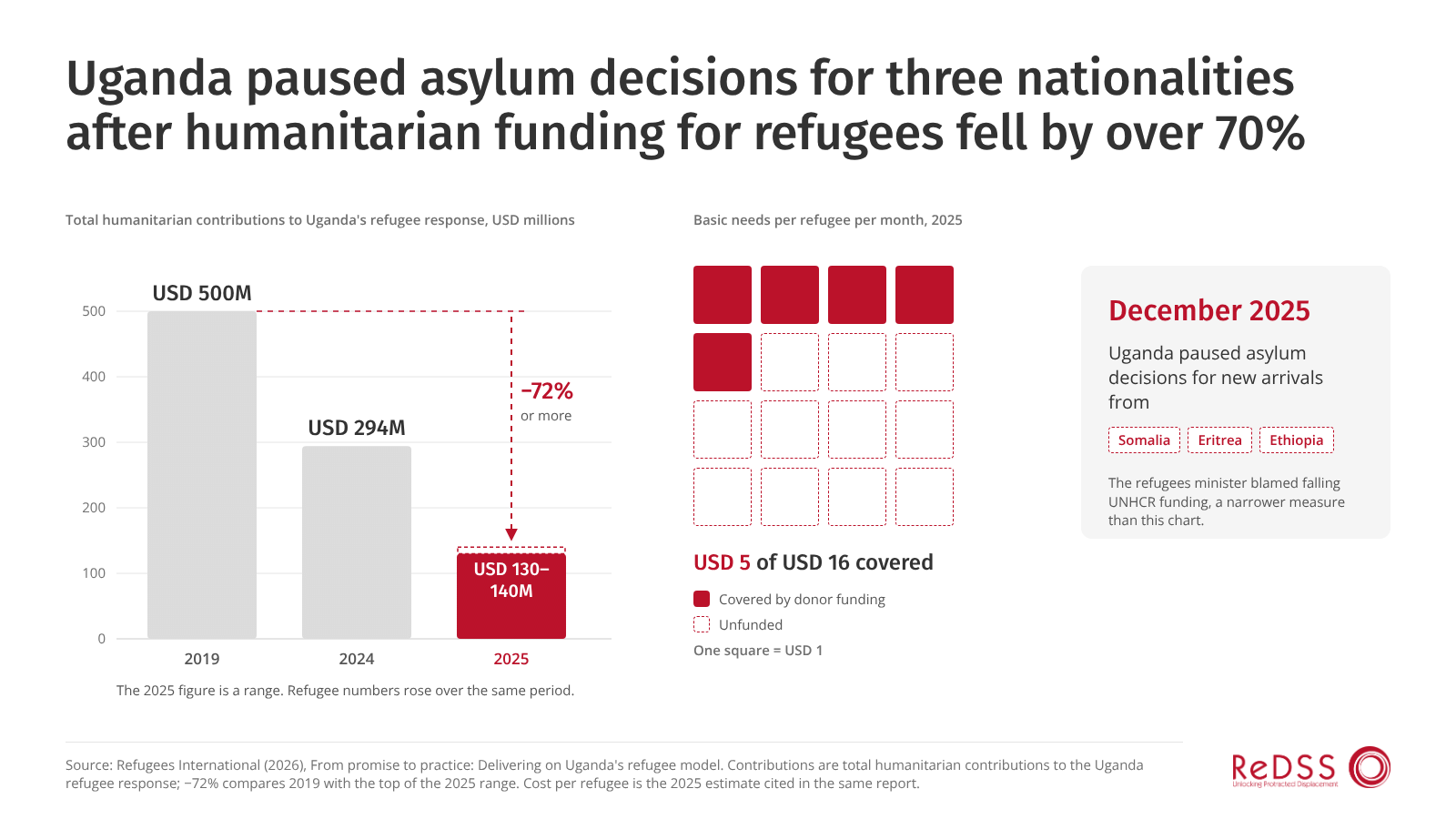
In Ethiopia, despite the 2019 right-to-work directive, only about 5.2 percent of working-age refugees held a permit to work or run a business, according to a 2025 World Bank working paper. The Intergovernmental Authority on Development (IGAD) Djibouti Declaration on refugee education built regional political will, according to a 2024 evaluation commissioned by IGAD and UNHCR, but the same evaluation found that none of its seven signatory states had fully integrated refugee schools into national education systems, years after signing. And funding shortfalls have forced hard trade-offs even in the region’s most-cited models: in December 2025 Uganda suspended refugee status determination for new arrivals from Somalia, Eritrea and Ethiopia, and its refugees minister tied the pause to falling UNHCR funding. Total humanitarian contributions to Uganda’s refugee response fell from about USD 500 million in 2019 to USD 294 million in 2024 and USD 130–140 million in 2025 (Refugees International, 2026). That is close to the situation Article II (4) was written for, a host state finding it hard to keep granting asylum, and we have found no record of an appeal under the clause. The gap between law and delivery predates the current funding crisis, but it has grown sharper inside it. That is the link Part 1 drew between the two promises: rights written into national law can only be delivered at scale if the cost of delivering them is shared.
Why the Clause's Few Uses Never Became a Mechanism
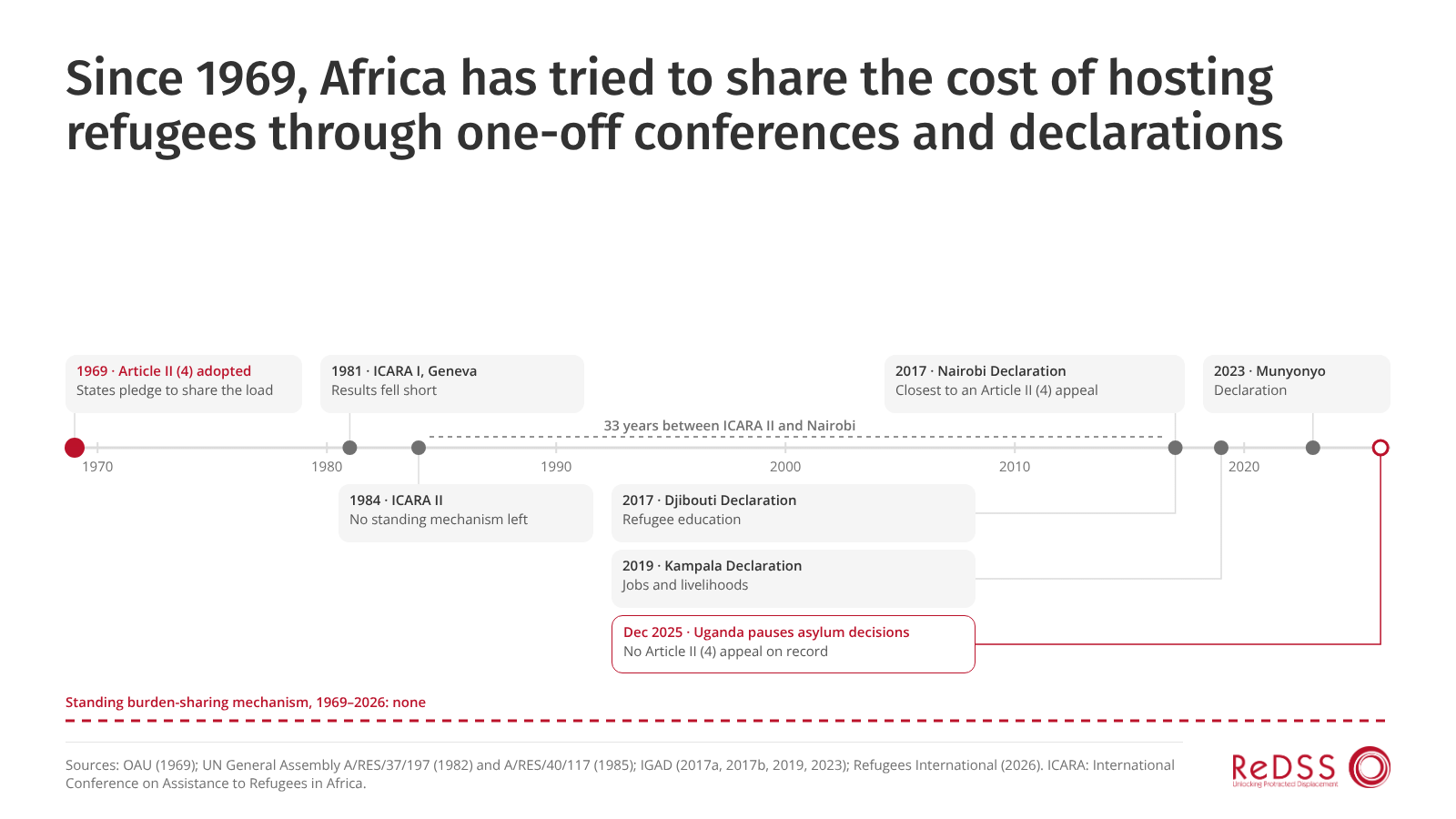
The first attempt to put Article II (4) into practice was the International Conference on Assistance to Refugees in Africa (ICARA), convened in Geneva in 1981 to convert the clause’s promise into real resources for the states then hosting the continent’s roughly five million refugees. A UN General Assembly resolution reviewing the first conference concluded that its results had “fallen short of the expectations of the African countries.” A second attempt in 1984 tried to fix that by linking aid to host-country infrastructure rather than emergency relief alone. It fared little better, and neither conference left a standing mechanism behind. The strongest case that the clause has been used since comes from 2017, when Kenya hosted the IGAD Special Summit on Somali refugees and the Nairobi Declaration asked member states and donors to share responsibility for a protracted regional caseload. That looks very like the appeal Article II (4) describes, and a fair reading could count it as one. What it did not do was name the clause or create a standing, formula-based way of sharing the cost, so each crisis since has started again from an ad hoc appeal.
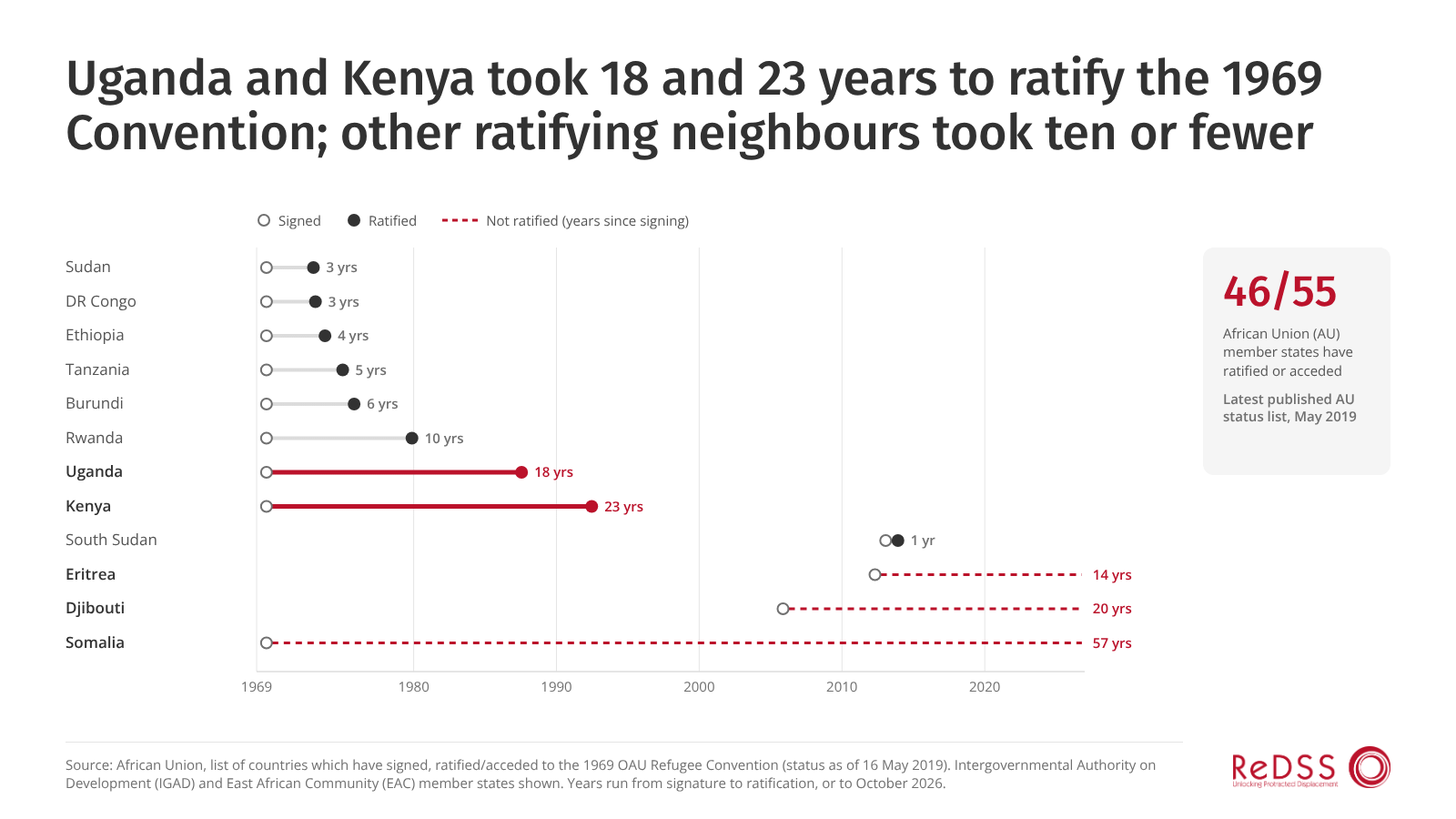
Why no standing mechanism has emerged is partly a matter of capacity and partly one of political priority. The states best placed to lighten another member’s load are themselves resource-constrained, already hosting large refugee populations of their own. The slowest ratifications point to the second: Kenya did not ratify the 1969 Convention until 1992, twenty-three years after signing it; Uganda ratified in 1987, eighteen years after signing; Somalia signed in 1969 and, per the African Union’s own treaty records, has never ratified it at all. Others in the region moved much faster: Sudan, the Democratic Republic of the Congo, Ethiopia, Tanzania and Burundi each ratified within six years of signing. As of the AU’s most recently published status list, 46 of its 55 member states have ratified or acceded, a solid majority that nonetheless took decades to assemble.
What Putting the Clause to Work Would Take
IGAD’s run of declarations since 2017, from Nairobi and Djibouti to Kampala and Munyonyo, has become something close to a working substitute, coordinating education, livelihoods, and health commitments across member states without ever citing Article II (4) directly. Built over nearly a decade of ministerial meetings and technical working groups, it amounts to the region rebuilding, piece by piece, a mechanism its own founding treaty already promised instead of simply switching it on.
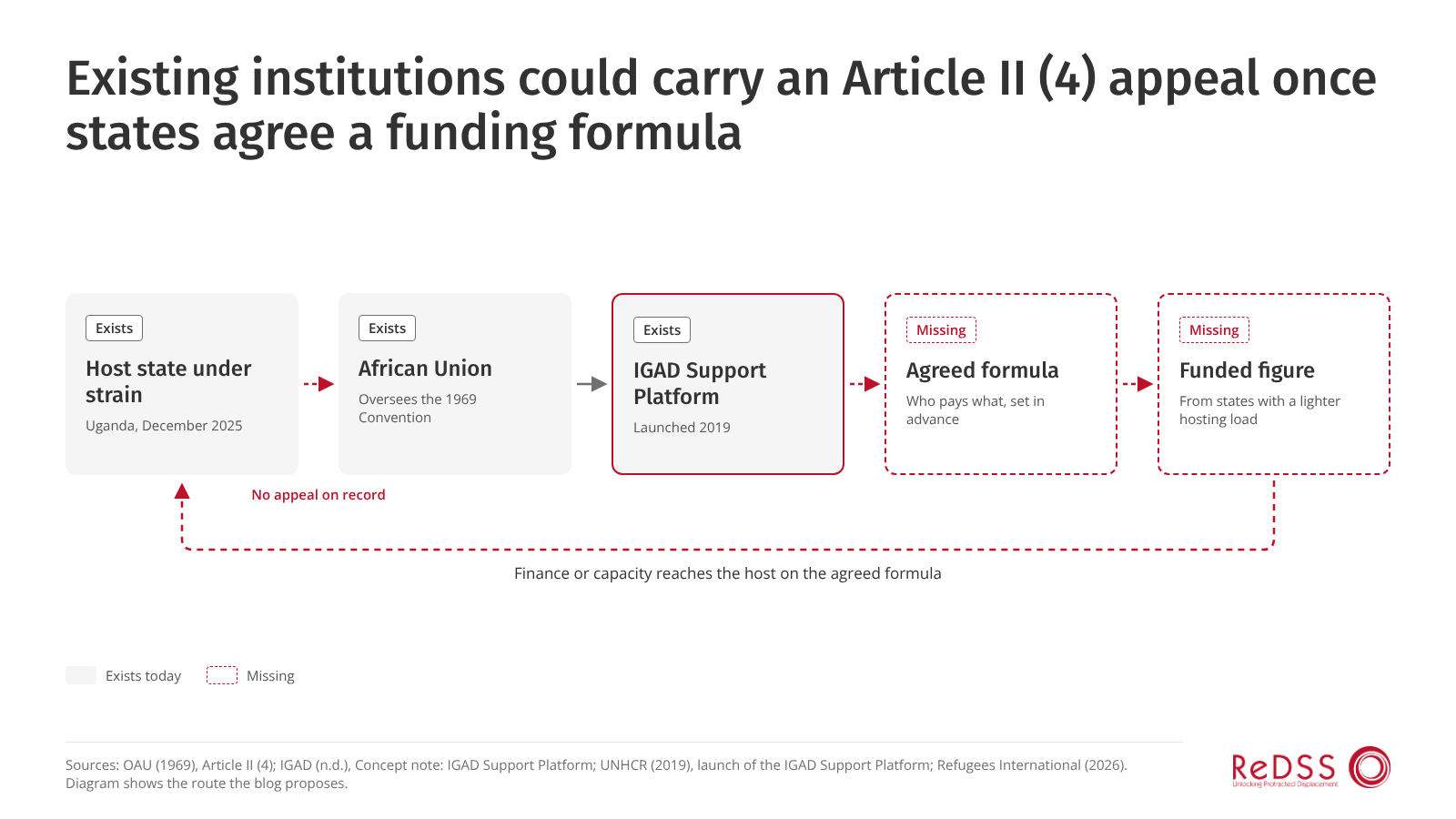
Switching it on would not require a new declaration; the region’s calendar already has four. It would mean a burdened member state making the appeal Article II (4) already provides for, through the African Union, which oversees the Convention. The IGAD Support Platform, the coordinating body IGAD and UNHCR launched in 2019 to follow up on the Nairobi Process that grew out of the 2017 summit, could then serve as the regional vehicle for something the region does not yet have: a standing instrument, even a modest one, through which member states carrying a lighter hosting load contribute financing or capacity to those carrying more, on an agreed formula rather than whatever each new appeal happens to raise. That is a smaller ask than it sounds, because the coordinating infrastructure already exists. What is missing is a decision to point that infrastructure at Article II (4) and put a funded figure behind it.
On this evidence, the answer to the question Part 1 left open is no, but for different reasons at each scale. Globally, the promise of shared cost is being let slide, one defensible decision at a time, by the states with the most capacity to keep it. Regionally, the same promise was written into binding law in 1969 and never built into a standing mechanism, by states with the least capacity to keep it and, as their slow ratifications show, other priorities ahead of it. In both cases the promise held on paper and stalled in practice, because no one was given the job of delivering it or a figure to deliver against. Seventy-five years after the 1951 Convention, that is still true at both scales.
Both promises, the global and the regional, were also made by states to each other. Neither the Convention’s global bargain nor Africa’s regional one gave the people seeking asylum any say in how either promise would be kept. Part 3 turns to them, and to what ReDSS’s own research finds when they are asked.
References
- African Union (n.d.). List of countries which have signed, ratified/acceded to the OAU Convention Governing the Specific Aspects of Refugee Problems in Africa. African Union. https://au.int/sites/default/files/treaties/36400-sl-OAU%20Convention%20Governing%20the%20Specific%20Aspects%20of%20Refugee%20Problems%20in%20Africa.pdf
- Federal Democratic Republic of Ethiopia (2019). Refugees Proclamation No. 1110/2019. Ministry of Justice. https://justice.gov.et/en/law/refugees-proclamation-proclamation/
- Government of Kenya and UNHCR (n.d.). Shirika Plan: An update. UNHCR Operational Data Portal. https://data.unhcr.org/es/documents/download/104460
- Government of Uganda (2006). Refugees Act, 2006 (Act 21 of 2006). Uganda Legal Information Institute. https://ulii.org/en/akn/ug/act/2006/21/eng@2006-08-04
- IGAD (2017a). Nairobi Declaration on Durable Solutions for Somali Refugees and Reintegration of Returnees in Somalia, 25 March 2017. Intergovernmental Authority on Development. https://igad.int/communique-special-summit-of-the-igad-assembly-of-heads-of-state-and-government-on-durable-solutions-for-somali-refugees/
- IGAD (2017b). Djibouti Declaration on Regional Refugee Education. Intergovernmental Authority on Development. https://igad.int/djibouti-declaration-on-quality-education/
- IGAD (2019). Kampala Declaration on Jobs, Livelihoods and Self-Reliance for Refugees, Returnees and Host Communities in the IGAD Region. Intergovernmental Authority on Development. https://igad.int/kampala-declaration-on-jobs-livelihoods-and-self-reliance/
- IGAD (2023). IGAD and EAC Member States sign Munyonyo Declaration on Durable Solutions for Refugees in the East and Horn of Africa, 16 June 2023. Intergovernmental Authority on Development. https://igad.int/igad-and-eac-member-states-sign-munyonyo-declaration-on-durable-solutions-for-refugees-in-the-east-and-horn-of-africa/
- IGAD (n.d.). Concept note: IGAD Support Platform for implementation of the Nairobi Declaration. Global Compact on Refugees Digital Platform. https://globalcompactrefugees.org/sites/default/files/2019-12/East%20and%20Horn%20of%20Africa;%20IGAD%20Support%20Platform%20for%20the%20Implementation%20of%20the%20Nairobi%20Declaration_0.pdf
- Organization of African Unity (1969). OAU Convention Governing the Specific Aspects of Refugee Problems in Africa. African Union. https://au.int/en/treaties/oau-convention-governing-specific-aspects-refugee-problems-africa
- Perez, A. M. and Rozo, S. V. (2025). From policy to practice: Lessons from the implementation of the refugee work rights policy in Ethiopia. Policy Research Working Paper 11254. World Bank. https://openknowledge.worldbank.org/server/api/core/bitstreams/8946510c-701c-40ab-948a-c40d9a2adba0/content
- Refugees International (2026). From promise to practice: Delivering on Uganda’s refugee model. Refugees International. https://www.refugeesinternational.org/reports-briefs/from-promise-to-practice-delivering-on-ugandas-refugee-model/
- Republic of Kenya (2021). The Refugees Act, 2021 (No. 10 of 2021). Kenya Gazette Supplement No. 210. Department of Refugee Services. https://refugee.go.ke/sites/default/files/downloads/Refugees-Act-2021.pdf
- UN General Assembly (1982). International Conference on Assistance to Refugees in Africa, A/RES/37/197, 18 December 1982. United Nations. https://www.unhcr.org/publications/international-conference-assistance-refugees-africa-1
- UN General Assembly (1985). Second International Conference on Assistance to Refugees in Africa, A/RES/40/117, 13 December 1985. United Nations. https://digitallibrary.un.org/record/113293
- UNHCR (1982). Report of the United Nations High Commissioner for Refugees (covering 1981). UNHCR. https://www.unhcr.org/publications/report-united-nations-high-commissioner-refugees-26
- UNHCR (2009). Uganda’s progressive Refugee Act becomes operational, 22 June. UNHCR. http://www.unhcr.org/4a3f9e076.html
- UNHCR (2014). Tanzania grants citizenship to 162,000 Burundian refugees in historic decision, 17 October 2014. UNHCR. https://www.unhcr.org/uk/news/latest/2014/10/5441246f6/tanzania-grants-citizenship-162000-burundian-refugees-historic-decision.html
- UNHCR (2024). An evaluation of progress of the inclusion of refugees in national education systems in the IGAD member States (EvO/2024/07). Jointly commissioned by IGAD and UNHCR. UNHCR Evaluation Office. https://www.unhcr.org/media/evaluation-progress-inclusion-refugees-national-education-systems-igad-member-states
- UNHCR (n.d.). Ethiopia: GCR in action. Global Compact on Refugees Digital Platform. https://globalcompactrefugees.org/gcr-action/countries/ethiopia