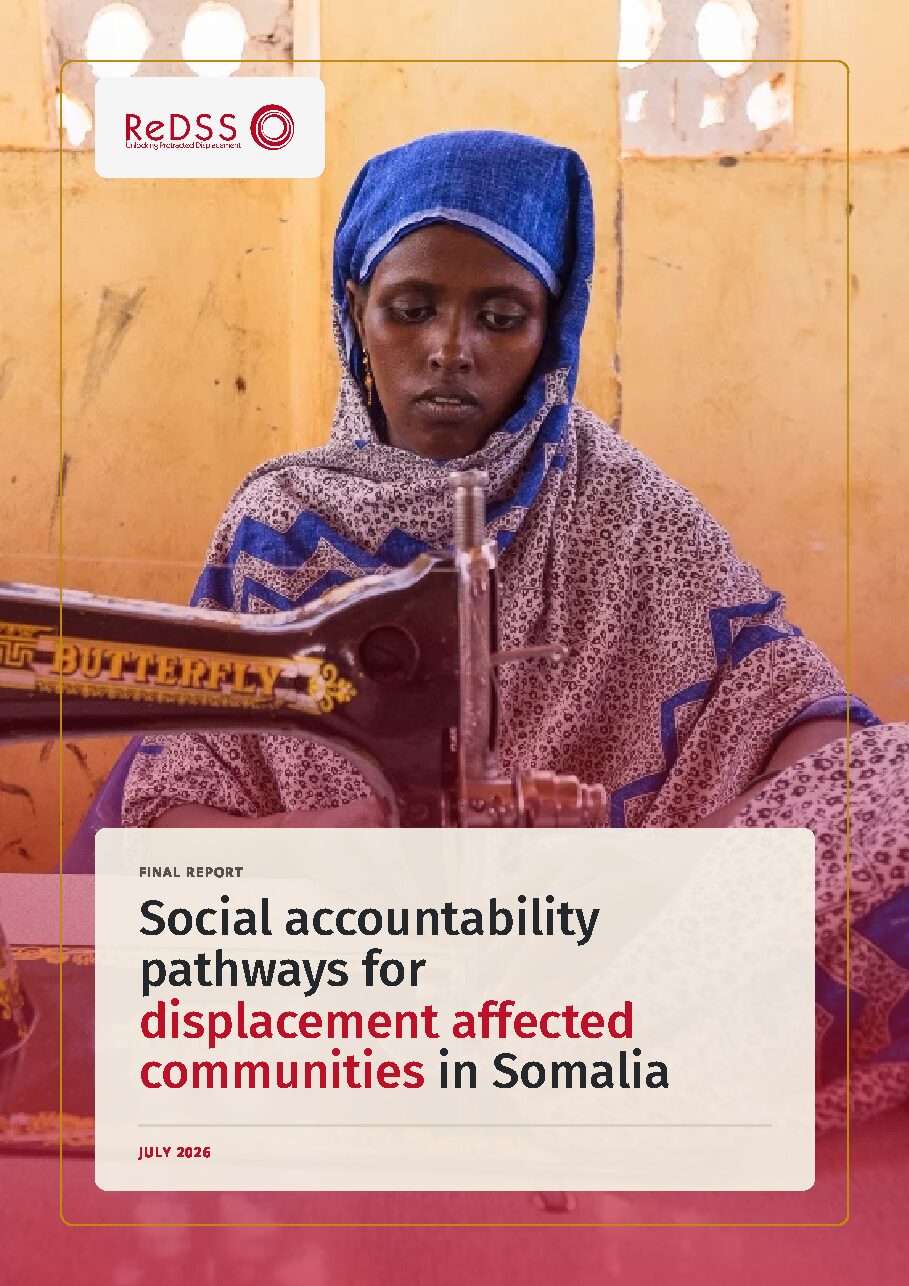
The National Solutions Pathways Action Plan (2024–2029) commits the Federal Government of Somalia to moving one million people out of displacement by 2029, with meaningful participation and accountability to communities as central aims. This study asks how displacement-affected communities currently engage with authority, what limits their ability to hold power to account, and how community oversight can be strengthened in ways that are politically feasible, economically sustainable and socially inclusive.
The research combined key informant interviews with aid actors, researchers, community representatives and federal, state and district officials; a light-touch social network analysis mapping whom people rely on and trust; and user journeys tracing real disputes and service problems step by step, from first contact to resolution or breakdown. Roundtables with stakeholders tested the findings and shaped the recommendations.
The findings show that accountability in Somalia runs through relationships. People draw on family, clan elders, camp leaders and committees in parallel, and support and influence concentrate around a small number of brokers. Formal authorities are approached rarely, and minority clan members, women and people with disabilities face the steepest barriers. Committees formed through aid programming are widely seen as aid delivery infrastructure, and camp leaders often control who sits on them. Fear of repercussions keeps many people from escalating problems.
The report proposes eight principles for aid actors, including avoiding parallel systems, investing in the points where formal and informal authority meet, working with existing clan and personal networks, treating inclusion as a political process, confronting elite capture, and designing for sustainability from the start. It is relevant to government institutions, durable solutions partners and donors working in Somalia.