Updated October 2026: this post was first published in April 2018 to announce the study. We have expanded it with a summary drawn from the study’s executive summary.
Between November 2017 and January 2018 we looked at how solutions-oriented programming was working for displaced people living in cities: refugees in Nairobi, and internally displaced people (IDPs) and refugee-returnees in Mogadishu and Baidoa. The study set out to understand displaced people’s vulnerabilities and aspirations in their own terms, to test the assumptions practitioners bring to urban programming, and to rethink support so that it is more sustainable and less dependent on aid.
Why cities matter for solutions in the Horn of Africa
Displacement in the region is still managed mainly through camps, but more IDPs, returning refugees and, to a lesser extent, refugees are moving to towns. Kenya hosted some 65,000 urban refugees at the time of the study, about 13% of its refugee population. In Somalia, drought pushed people from rural Bay, Lower Shabelle and Sool into Mogadishu and Baidoa. Many displaced people settle in marginalised neighbourhoods and become hard to see, while others join the visible urban poor, adding to pressure on housing, land, jobs and services.
How the study was done
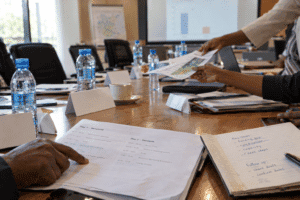
The study took a perceptions-based approach centred on displaced people’s own views, backed by a literature review. The team carried out 130 interviews with more than 250 people, including experts, operational agencies, government authorities, the private sector, civil society, researchers, and displaced and host communities. Findings were tested at validation workshops in Baidoa and Nairobi, and a steering committee of IRC, NRC, Oxfam, World Vision, INTERSOS and Samuel Hall guided the work.
The response framework held up; applying it proved harder than expected
The study judged the overall response framework positive, with a lot of untapped potential. What was missing was a more deliberate, strategic application of principles already agreed. Turning those principles into operations had proved harder than expected, and technical support had not kept pace with the growing responsibilities placed on local actors.
In Nairobi, agencies had done relatively well at helping refugees use existing services. Operational actors described a shift towards a self-reliance “mind-set”, and most refugees interviewed asked for support to become self-reliant. But reach was small next to the size of the urban refugee population, and the main complaint was about scale, particularly of cash grants. Refugees also reported persistent police harassment, often involving demands for bribes, even when their documents were in order.
Mogadishu and Baidoa looked different. With little infrastructure, limited state capacity and frequent emergencies, programmes concentrated on essential needs, and self-reliance activities reached few people. Officials and communities asked NGOs to keep that emergency focus. IDPs faced sexual violence and forced evictions, with little response from authorities. Multi-year funding had allowed a longer inception period, which helped lay foundations for solutions-oriented work.
In all three cities, displaced people’s skills were poorly captured and underused, while remittances and community safety nets mattered more than programmes tended to recognise. Displaced people often lived alongside the poorest hosts, and competition for scarce services created tension. Social cohesion was widely seen as relevant but was rarely central to programme design.
Five recommendations for agencies and donors
- Match in-house skills to the new demands: move from needs-based to capacity-based assessments, and build staff skills in supporting social change.
- Apply area-based and whole-of-society approaches deliberately rather than by coincidence, with the time and resources to map partners and local power dynamics.
- Put local authorities at the centre. In Nairobi, that means working with municipal and county authorities and exploring community policing and documentation solutions. In Somalia, it means bringing humanitarian, development, traditional and formal authorities together around Community Action Plans.
- Make social cohesion an explicit objective with its own indicators, and quantify displaced people’s contributions to their host cities so they are seen as a benefit.
- Keep moving towards adaptive programming, including donor mechanisms that allow it, and use Somalia’s experience of multi-year funding to inform approaches in Nairobi.
The study was funded by ECHO and the Danish Embassy for Kenya and Somalia.
Read the full report, the executive summary and the summary presentation.
References
ReDSS (2018). Analysis of Solutions Planning and Programming in Urban Contexts: Executive Summary. Regional Durable Solutions Secretariat. https://www.regionaldss.org/wp-content/uploads/2018/04/ReDSS-Urban-study-executive-summary.pdf