What the Qolaji Validation Workshop Found
Qolaji is the largest internally displaced persons (IDPs) settlement in Ethiopia’s Somali Region, hosting over 98,000 people who were forced to flee East and West Hararghe after waves of insecurity and ethnic violence between 2016 and 2017. Years later, many families are still struggling to rebuild their lives, with the lack of official identity documents remaining one of the biggest barriers to accessing basic services and livelihood opportunities.
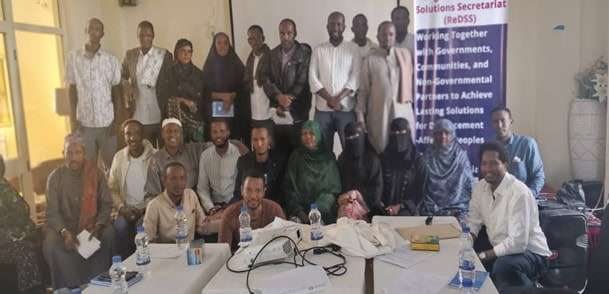
In response, UNHCR and the Somali Regional Disaster Risk Management Bureau launched a joint documentation effort in 2025 to close this gap. Building on that work, the Regional Durable Solutions Secretariat (ReDSS), together with the Somali Regional State Government and UNHCR, convened a validation workshop in April 2026 in Jigjiga. The workshop brought together government officials, humanitarian partners, researchers, and displacement-affected community (DAC) representatives to review findings from the Qolaji documentation survey and identify practical ways forward.
Living Without Identity
The survey findings revealed a reality that is both urgent and deeply structural. In Qolaji, 83% of IDPs remain undocumented, and only 5% have received the Fayda National ID (Qolaji Documentation Survey, April 2026). This lack of formal identification is not a peripheral issue: it shapes every aspect of daily life. The same survey found that families spend most of their income on survival, with 77% of expenditure going to food, and that half of respondents report having no stable income. For many, humanitarian aid remains the only reliable source of food, shelter, healthcare, and basic services, because stable livelihoods are absent and public systems, including healthcare facilities, schools, social protection services, and employment, are either overstretched, under-resourced, or structurally unable to include IDPs. Prolonged displacement erodes traditional coping mechanisms, disrupts social networks, and limits access to education and income-generating opportunities, leaving households highly dependent on external support.
Yet beyond these figures lies a deeper human story. Community representatives describe life without documentation as “a life suspended.” People who once farmed, herded livestock, and ran small businesses now find themselves unable to work, access services, or prove who they are in critical moments. Children experience this suspension in ways that shape their entire futures. Without documentation, many cannot enrol in school, sit for national exams, or receive certificates that validate their education. A child without recognized identity may grow up excluded from opportunities their peers take for granted, carrying uncertainty into adulthood. Access to healthcare, protection services, and basic rights becomes inconsistent, leaving children more vulnerable to neglect, exploitation, and child labour. The absence of documentation erodes not only economic opportunity but also a sense of belonging, turning capable, resilient individuals into passive recipients of aid, not by choice, but through systemic exclusion.
Registration Is Outpacing the Resources Behind It
The Fayda ID initiative aims to provide national digital identification cards to 100,000 IDPs and 30% of the surrounding host community, with the goal of improving access to essential services, strengthening inclusion, and enhancing protection for vulnerable populations. As of 2025, following the joint documentation effort described above, 12,966 individuals had already received their national digital IDs out of 30,679 registered people in Qolaji.
Despite this progress, significant challenges remain. Workshop participants candidly identified operational and systemic constraints affecting implementation, including limited technical capacity, recurring network failures that disrupt registration, and procedural barriers that disproportionately affect women and youth.
The ambitious target of registering tens of thousands of IDPs is also outpacing available financial, technical, and operational resources. Participants emphasized the need for stronger coordination, increased investment in infrastructure and staffing, and targeted measures to make registration more inclusive and efficient. Addressing these constraints is critical to ensuring that vulnerable communities are not left behind.
A Call to Collective Responsibility
What emerged from the validation workshop was not merely a set of findings but a call to action directed at a wide range of stakeholders. One point kept coming up across the discussions: documentation is far more than an administrative requirement. It is a gateway to visibility, dignity, rights, inclusion, and durable solutions. The workshop reinforced a shared understanding that legal identity is not a standalone intervention but a foundational enabler of protection, access to services, socio-economic participation, and long-term recovery.
The Qolaji survey findings underscored the urgent need to ensure that all eligible IDPs have access to legal documentation to exercise their rights and pursue opportunities. Legal identity, participants agreed, is fundamental to resolving protracted displacement, facilitating local integration and reintegration, and creating pathways toward self-reliance. Documentation is a prerequisite for accessing education, healthcare, livelihoods, financial services, and government support, while also enabling broader participation in social and economic life.
What Each Stakeholder Is Being Asked to Do
The workshop also stressed the importance of embedding documentation efforts within formal governance systems. For government institutions, the priority is strengthening coordination between regional authorities, local administrations, and sectoral actors so that registration and documentation initiatives integrate into existing government systems rather than operating through parallel humanitarian structures. This approach would strengthen accountability, sustainability, and local ownership, and align with broader government registration roadmaps and durable solutions strategies.
For donors, the message was equally clear: investments in legal identity and documentation systems generate far-reaching benefits across protection, service delivery, livelihoods, and social cohesion. Sustained support is needed not only for registration activities but also for the systems, outreach mechanisms, and institutional capacities that ensure documentation translates into meaningful access to rights and opportunities.
For UN agencies and international NGOs, the findings point to the need to move beyond fragmented programming and integrate documentation more systematically into durable solutions, protection, and development initiatives. Civil society organizations have a critical role in building trust and engaging communities, and in ensuring that marginalized groups, including women, youth, and people with disabilities, are not left behind. Academic and research institutions can strengthen the evidence base by analysing the relationship between legal identity, service access, social cohesion, and durable solutions. The private sector can use digital identity systems to expand financial inclusion and economic participation.
Qolaji as a Model for Other Displacement Sites
Participants also viewed the Qolaji experience as more than a one-time assessment and regarded it as a strategic pilot with lessons applicable to other displacement-affected locations across the Somali Region and beyond. The findings show how evidence-based approaches can inform policy, programming, and coordination while offering practical solutions to documentation barriers. With sustained political commitment, adaptable implementation frameworks, and strong partnerships, similar approaches can work in other contexts while remaining responsive to local realities.
Post-workshop evaluation feedback reinforced the value of both the survey and the validation exercise. Participants noted that the assessment provides a strong baseline for future programming and a critical tool for understanding the impact of legal identity among displacement-affected populations. Several respondents emphasized that the findings could help policymakers identify gaps, formulate targeted interventions, and develop sustainable solutions. Others highlighted the importance of disseminating findings through regional coordination platforms, including the Durable Solutions Working Group (DSWG), to promote learning and coordinated action.
As Ethiopia and its partners look ahead, the challenge is no longer to demonstrate the value of documentation. The evidence is clear. The challenge now is to scale successful approaches, make them more inclusive, and connect them meaningfully to broader systems of governance, development, and durable solutions. Stakeholders recommended one clear next step: replicate similar surveys in other displacement sites, with deeper analysis and stronger gender dimensions.
The question is not whether displacement-affected communities can rebuild their lives. It is whether systems will recognize them, support them, and open the pathways needed for them to do so.