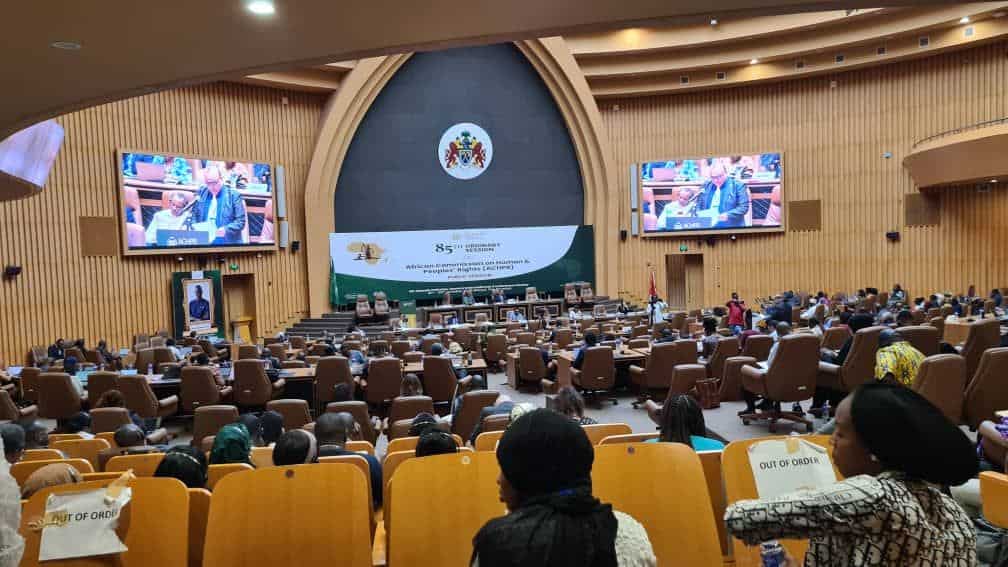
In late October 2025, I represented the Regional Durable Solutions Secretariat (ReDSS) at the 85th Ordinary Session of the African Commission on Human and Peoples’ Rights (ACHPR), held in Banjul, The Gambia. I also panelled at a side event bringing together advocates, governments, and refugee voices to tackle one of the region’s most persistent protection gaps: refugees’ right to move freely and access documentation.
The ACHPR operates through subsidiary mechanisms including the Special Rapporteur on Refugees, Asylum Seekers, IDPs, and Migrants in Africa, led by Commissioner Salma Sassi Safer. NGOs like ReDSS participate by submitting shadow reports, monitoring state compliance, and raising awareness.
The Side Event: Borderless Justice
“Borderless Justice: Advancing Freedom of Movement for Forcibly Displaced Persons in the East and Horn of Africa” convened on 24 October during the ACHPR to advance multi-stakeholder dialogue and examine barriers preventing refugees from participating fully in economic, social, and civic life.
The legal architecture is substantial. Article 13 of the Universal Declaration of Human Rights (1948) guarantees freedom of movement within a state’s borders. The 2018 AU Free Movement Protocol extends this across borders within Africa. The IGAD Nairobi Declaration (2017) and EAC Common Market Protocol add further regional protections, governing refugee movement under the 1951 Geneva Convention and 1969 OAU Refugee Convention. National-level restrictions nonetheless continue to undermine protection in practice.
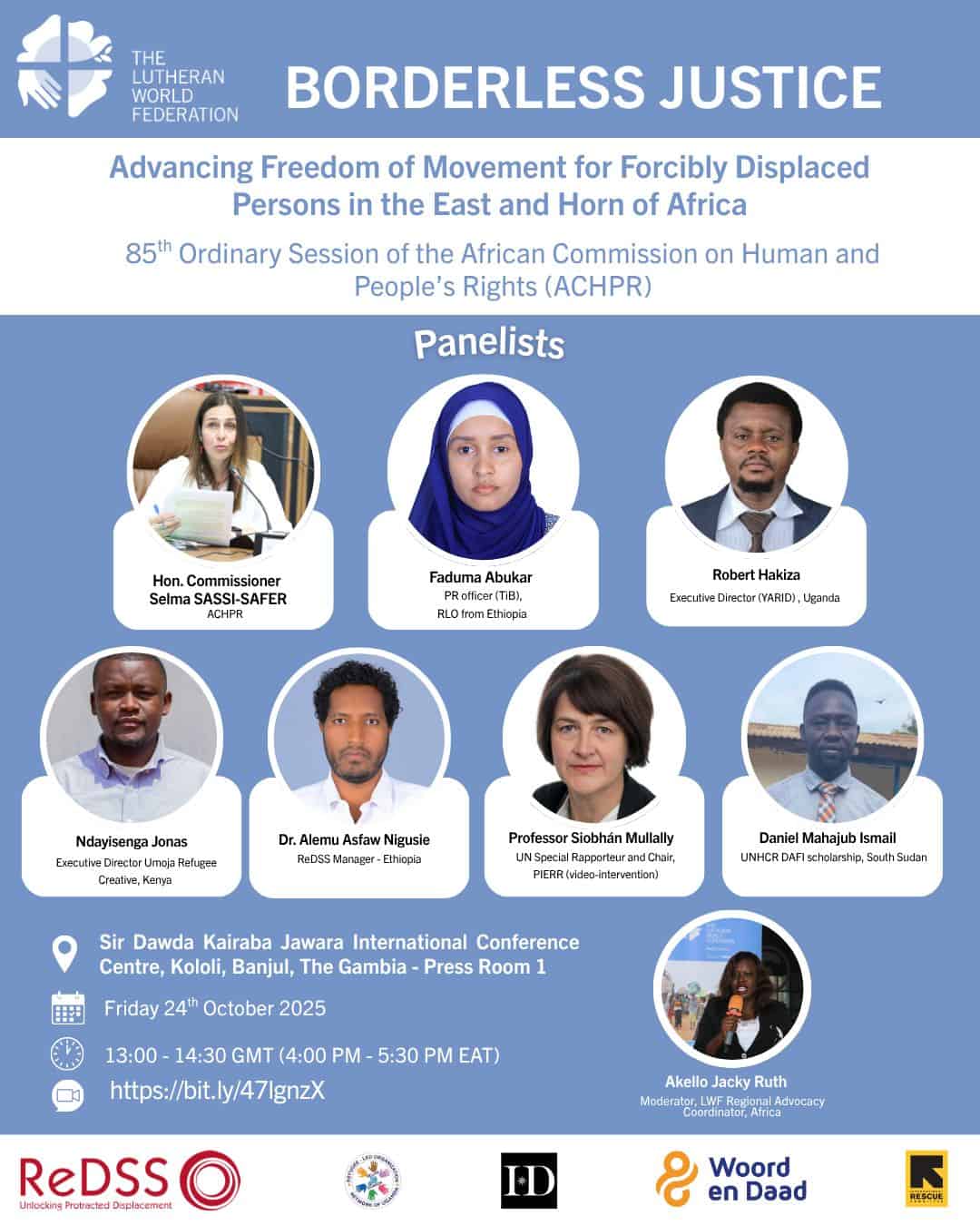
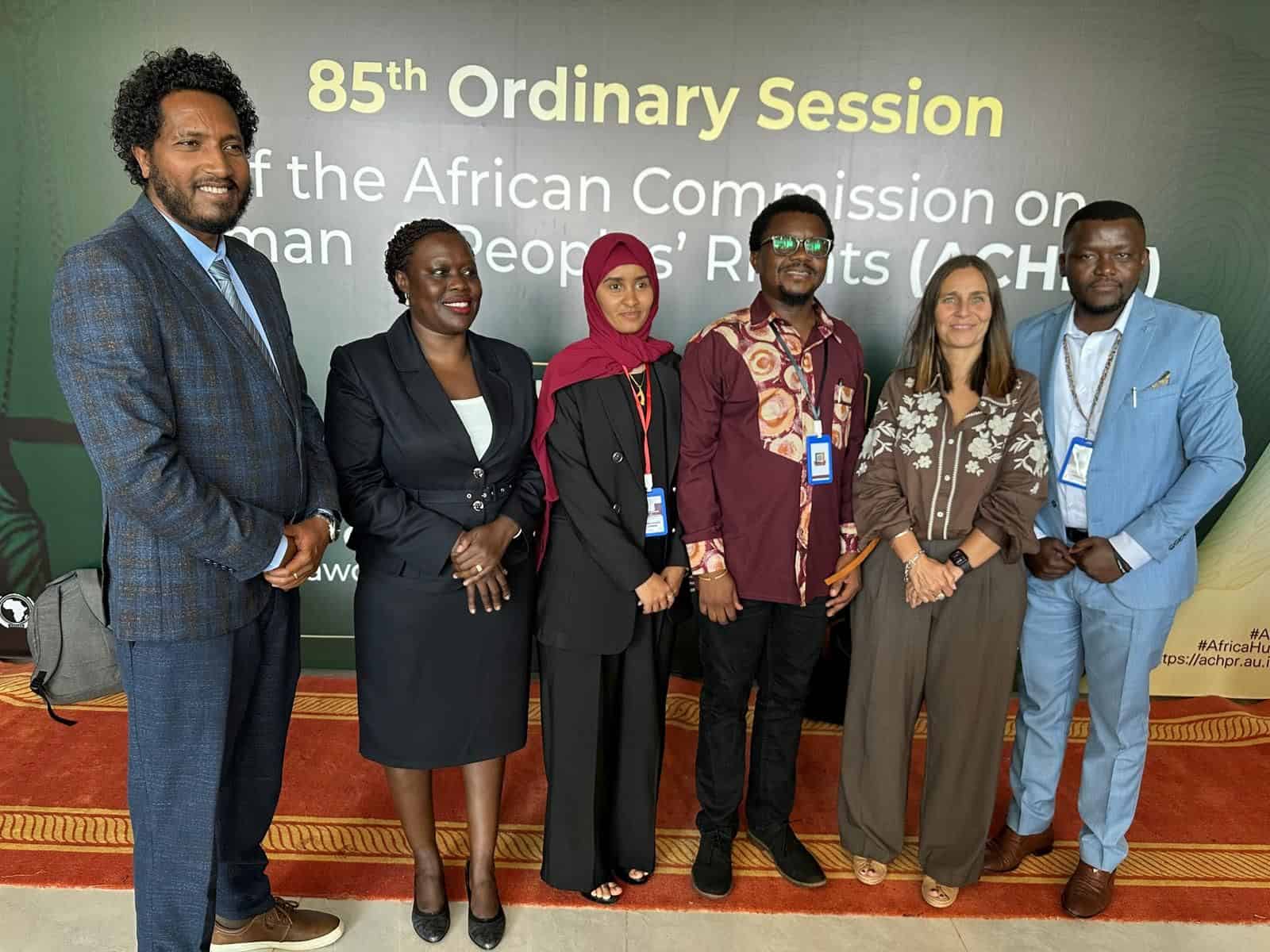
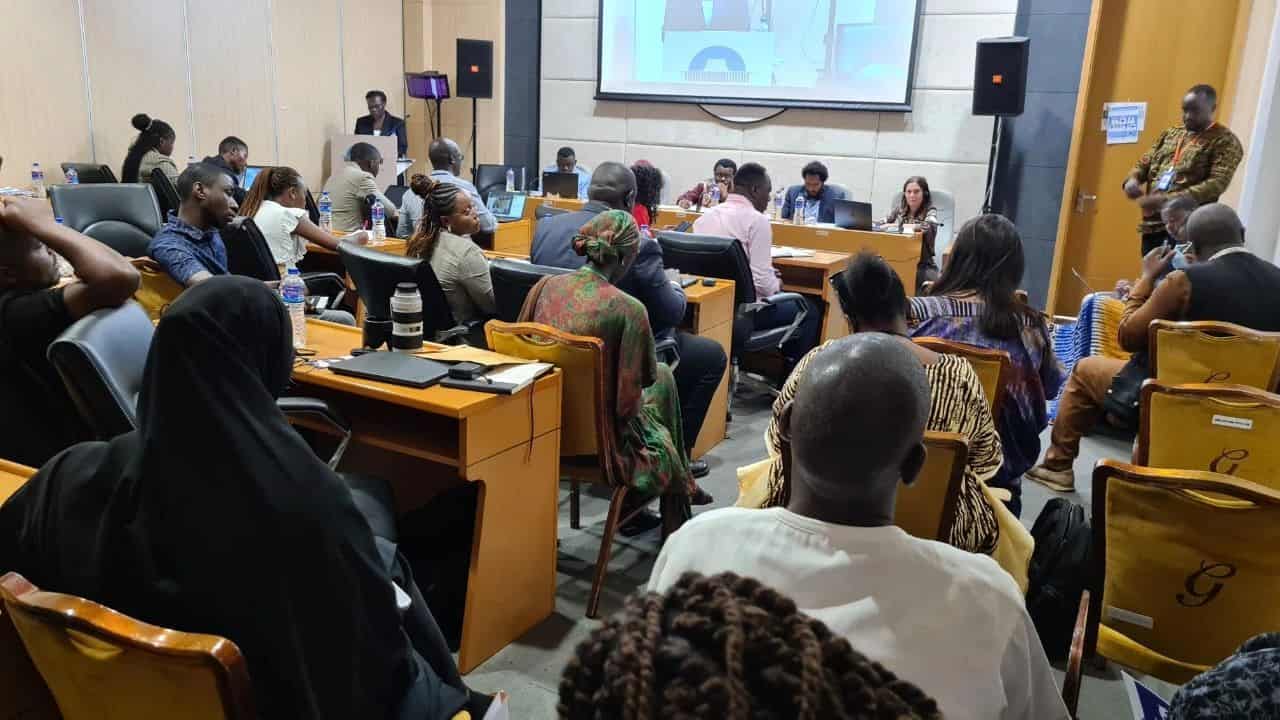
Clockwise from right: 1) The Session poster with panellists and session details, 2) Panellists take a photo outside the hall after the session, and 3) a cross-sectional view of the session in progress
The featured panel for this session included Commissioner Selma Sassi-Safer (ACHPR), Professor Siobhán Mullally (UN Special Rapporteur, pre-recorded), Robert Hakiza (YARID, Uganda), Faduma Abukar (Tomorrow is Better, Ethiopia), Ndayisenga Jonas (Umoja Refugee Creative, Kenya), Daniel Mahadu (UNHCR DAFI Scholar, South Sudan), and myself representing ReDSS. Akello Jacky Ruth of the Lutheran World Federation (LWF) moderated.
What Panellists Said
Professor Mullally stressed that freedom of movement cannot stop at borders. With over 123 million people forcibly displaced globally, she urged African states to implement the 2018 Protocol and enforce Article 24 of the African Charter, noting these frameworks are routinely not applied to refugees. She called for inclusive policies enabling refugees to establish businesses, obtain travel documents, and access livelihoods, and flagged climate change as an accelerating driver of displacement.
Commissioner Sassi-Safer called on states to eliminate work permit requirements, enforce Convention Travel Documents (CTDs), and strengthen NGO and RLO collaboration. She stressed that credible civil society evidence is essential and that implementation, not the absence of legal standards, is the core challenge.
Country Realities: Rights on Paper, Barriers in Practice
Uganda grants refugees the right to work and move freely, but cross-border travel restrictions and limited RLO recognition persist. Kenya requires movement passes that are routinely delayed or denied; a July 2025 memo suspending address changes has deepened the paralysis. Ethiopia requires revocable camp pass permits and still issues handwritten, machine-unreadable CTDs that airlines and borders reject. South Sudan arbitrarily revokes nationality based on ethnicity. The 2025 ACHPR ruling in Afekuru Animu Risasi Amitai v. Republic of South Sudan confirmed the pattern, finding multiple Charter violations after a citizen was unlawfully rendered stateless.
The ReDSS Perspective: Movement as a Durable Solution
Women and children make up 76 to 78 percent of the refugee population in the region and bear the heaviest burden of mobility restrictions. I called for policies that balance national interests with international obligations, sustained international investment, and gender-sensitive, inclusive approaches. For ReDSS, freedom of movement connects directly to durable solutions: protection, area of residence, access to services, and economic inclusion. Removing travel and documentation barriers, inside host countries and across borders, is central to enabling refugee self-reliance.
Key Recommendations
- Strengthen implementation of existing regional and national frameworks guaranteeing freedom of movement.
- Eliminate work permit and internal movement pass requirements for refugees.
- Issue machine-readable CTDs and harmonize their recognition across countries.
- Support host governments through targeted funding and capacity-building.
- Include refugee voices in policymaking.
- Strengthen legal literacy among refugees about their rights.
- Integrate gender-sensitive and youth-focused approaches across all mobility initiatives.
Lessons Learned and the Way Forward
Freedom of movement and access to documentation are not privileges. They are fundamental rights enabling refugees to live with dignity and contribute to host economies. The event surfaced a critical evidence gap: key stakeholders lack adequate information about refugees’ lives, and RLOs need sustained support to influence policy effectively.
The session opened two avenues for ReDSS: continental advocacy for freedom of movement, and new partnerships. Building on the Banjul momentum, ReDSS co-hosted a post-Banjul event in Addis Ababa on 17 November 2025 and will continue working with LWF and like-minded organizations to advance documentation access and freedom of movement across East and Horn Africa.
Acknowledgements
ReDSS thanks the Lutheran World Federation (LWF), Independent Diplomat (ID), International Rescue Committee (IRC), Woord en Daad, and RELON Uganda. Special thanks to Collins Omondi (LWF Kenya), Akello Jacky Ruth (LWF Uganda), and Ester Wolf and Isaiah Toroitich (LWF Geneva) for leading the side event from inception to completion.