Updated October 2026: this post was first published in April 2020 to share the curriculum. We have expanded it with a summary drawn from the training guide.
Area-based approaches have become a common reference point in durable solutions planning in the region, but leading or taking part in one requires skills that many practitioners and officials have not had the chance to build. We designed a face-to-face training curriculum to close that gap, so that practitioners and policy makers are better equipped to lead and take part in area-based solutions planning for displacement-affected communities. The training was first piloted in Jigjiga, the capital of Ethiopia’s Somali Regional State, in March 2020, with plans to roll it out at woreda, regional and federal levels in Ethiopia and in other countries where ReDSS works.
What an area-based approach is
The curriculum uses a definition that puts place first: an area-based approach takes a defined area, rather than a sector or a target group, as the main entry point. All the stakeholders, services and needs in that area are mapped and assessed, and the relevant actors are brought together and coordinated. In displacement contexts, this means planning for refugees, internally displaced people and host communities together rather than through separate programmes for each group.
Who it is for
The training is aimed at policy makers and practitioners from national and local authorities, UN agencies, civil society, international NGOs and other local actors. The guide recommends a balanced mix of participants from these groups, gender balance where possible, and no more than 30 people per workshop, so that discussion and group work stay manageable.
How the curriculum is structured
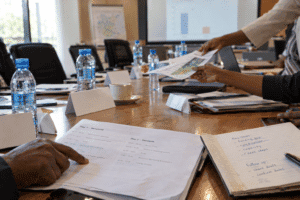
The workshop runs over two to two and a half days and is modular, so sessions can be adapted, shortened or dropped to suit the context. After an introduction that sets out the international, regional, national and local context, seven sessions follow. The first covers durable solutions, displacement-affected communities and the added value of an area-based approach. The second turns to how it is done, using ten guiding elements and looking at how to define an area and its target populations. The third covers preparation for a planning process involving many sectors and stakeholders, including coordination mechanisms and national ownership. The fourth deals with evidence-based planning through durable solutions analysis, including data, tools and adapting indicators. The fifth focuses on community-based planning and community action plans, accountability to affected populations, and linking community plans to local planning. The sixth covers monitoring, evaluation and adaptive management, and the seventh helps participants develop context-specific recommendations and a short action plan.
How participants learn
The methods are participatory: short presentations, group and individual reflection, practical exercises, case studies, problem-solving, consensus building, brainstorming, and videos, pictures and readings, with energisers to keep the pace up. The guide also suggests optional focuses that trainers can add depending on participants’ needs. Throughout, three themes recur: social cohesion, community engagement and government engagement.
Six messages that run through it
The curriculum is built around six overarching messages: define the area and focus on its whole population; treat social cohesion as part of solutions, using conflict-sensitive analysis; use participatory, community-based processes; plan on the basis of shared and regularly updated evidence; build on existing community structures, plans and interventions rather than starting from scratch; and keep processes government-led, with support to strengthen authorities’ capacity. By the end, participants should be able to explain the added value of area-based approaches, apply their elements to the durable solutions planning cycle, and lead or take part in inclusive, government-led planning processes.
The ReDSS Durable Solutions Framework underpins the analysis sessions.
Read the training guide.
References
ReDSS (2020). Area-based approaches to durable solutions: training curriculum and facilitator guide. Regional Durable Solutions Secretariat. https://www.regionaldss.org/wp-content/uploads/2024/02/ReDSS_Area-Based-Curriculum_Interactive.pdf