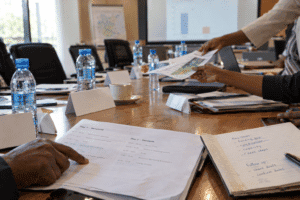
In early November 2025, 15 government officials gathered in Gode City, Shabelle Zone, for training that addressed a critical gap in Ethiopia’s displacement response: local technical capacity to implement durable solutions.
The two-day workshop, held November 5-6, followed the Somali Regional State’s request to strengthen zonal capacity for activating the Sub-Durable Solutions Working Group. The training followed regional-level capacity building conducted in August 2025, extending technical knowledge to staff who work directly with displacement-affected communities (DACs).
Why Shabelle Zone?
Shabelle Zone was selected for specific strategic reasons. The zone is one of two areas in the Somali Regional State where the government plans to establish and operationalize a sub-zonal Durable Solutions Working Group.
According to the Disaster Risk Management Bureau, the zone hosts 48,162 internally displaced persons (IDPs). Many have been relocated, creating direct demand for coordinated, informed interventions.
Beyond displacement, Shabelle Zone faces recurrent humanitarian needs from seasonal floods and recurring droughts. These repeated shocks exacerbate vulnerability, undermine livelihoods, and increase the risk of new displacement. The combination of a large, displaced population, planned coordination structures, and repeated climate-related shocks made this zone critical for capacity-building.
What the Training Covered
The training aimed to enhance zonal staff capacity to plan and implement area-based durable solutions. Participants explored foundations of area-based approaches, emphasizing how geographically focused planning brings different stakeholders around shared priorities. Modules on community-based planning and Community Action Plans highlighted the importance of inclusive engagement, local leadership, and community ownership.
Sessions addressed multisectoral and multistakeholder planning processes, providing guidance on coordinating interventions across different sectors. Participants learned about using durable solutions analysis to identify vulnerabilities, capacities, and priorities among DACs.
The training also covered international, national, and Somali regional normative frameworks relevant to durable solutions, strengthening understanding of standards and policies shaping displacement responses in Ethiopia. Housing, Land, and Property (HLP) considerations were discussed, recognizing their role in enabling long-term stability.
Strong Engagement from Field Staff
The training used a two-way communication approach, creating an interactive learning environment. Rather than one-sided lectures, sessions encouraged open discussion, questions, and experience sharing.
This approach proved effective because participants were field-based staff who brought practical knowledge and firsthand insights. Their real-life experiences deepened discussions and made the training relevant to the local context. Participation levels remained very strong throughout, with active engagement demonstrating clear understanding and strong interest in applying durable solutions approaches in daily work.
A Critical Observation
One key observation emerged: local-level staff are the group that most needs durable solutions capacity-building support. Before the training, many participants had limited knowledge of key durable solutions principles, approaches, and normative frameworks.
However, these actors work closest to DACs and play a central role in translating policy into action. Continuous capacity development for local actors is essential to strengthen durable solutions implementation at the grassroots level.
Measuring Learning Progress
Pre- and post-training tests assessed learning progress across 14 participants. The assessment covered displacement categories, durable solutions criteria, solution pathways, African normative frameworks such as the OAU and Kampala Conventions, community mobilization approaches, data collection rationale, multistakeholder approaches, HLP rights, and Community Action Plans.
Pre-test scores ranged from 20 to 70, averaging 40.7 out of 100, indicating varied but generally limited baseline familiarity. Post-test scores ranged from 30 to 80, averaging 54.3. The mean improvement across participants was 13.6 points. Thirteen of 14 participants demonstrated score increases, while one remained unchanged. No participants showed a decline.
The results show improved recall and comprehension of concepts presented during training. While the results do not measure practical skills or field application ability, they do show increased understanding of key durable solutions and area-based programming concepts. Participants with lower post-test scores may benefit from additional reinforcement to ensure concepts can be applied to their work contexts.
Lessons and Next Steps
The training highlighted several insights. ReDSS members operating at the ground level require further induction training, so durable solutions approaches can be effectively mainstreamed across their projects rather than implemented in isolation.
The training also revealed the need to extend durable solutions training to a wider range of local stakeholders. Providing training to government sectoral offices at the Woreda level, city administrations, municipalities, civil society organizations (CSOs), and coordination structures would enhance coordination, shared understanding, and collective ownership at the local level.
The training reinforced that durable solutions work most effectively through strong collaboration among multiple actors, especially between government institutions, CSOs, and coordination platforms operating locally. Focusing capacity-building efforts on local actors creates a foundation for sustainable impact.